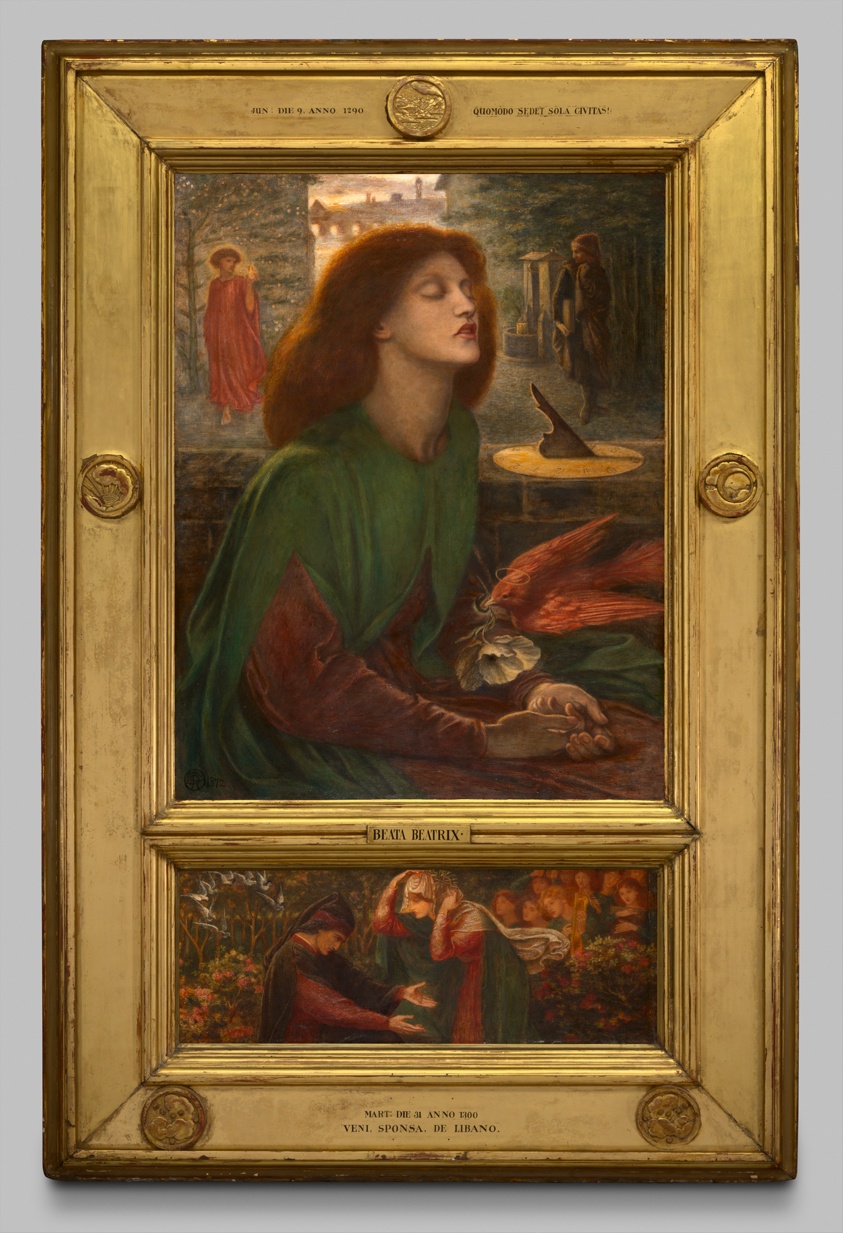
Beata Beatrix
Dante Gabriel Rossetti · 1871–72 · Art Institute of Chicago
What did you think?
Guide
4 chapters · about 2 minAdjust the guideNew to it · Medium
A Portrait in a Trance
This is an oil painting on canvas, a little under a metre tall, about thirty-four inches by twenty-seven. It shows a woman in a trance or other spiritual state. Dante Gabriel Rossetti painted it as a tribute to his wife and muse, Elizabeth Siddal, who had recently died. Along the bottom runs a narrow painted strip called a predella, which is a small scene set beneath a larger picture. The frame is part of the work too, because Rossetti designed it himself. The style is called Pre-Raphaelite, which looked back to medieval art.
Symbols to Find
Look above the woman's head, where the Ponte Vecchio, a famous bridge in Florence, rises in the distance. In the upper left is a figure of Love, and on the right stands Dante, who also represents Rossetti himself. A dove with a halo brings her a white poppy. Rossetti nicknamed Siddal "the Dove," and the poppy points to laudanum, a drug made from opium, which caused her death by overdose. Then find the sundial, where a shadow falls on the number nine. At the top right of the frame is a line of writing.
A Poet's Second Version
Rossetti was both a poet and a painter, and a founder of the Pre-Raphaelite Brotherhood, a circle of Victorian artists who admired medieval art. His inspiration was La vita nuova, or The New Life, a work by the Italian poet Dante Alighieri from 1295. Rossetti set his own love for his late wife beside Dante's love for the late Beatrice. The picture was so personal that he first refused his patron William Graham's request for a copy, but he finally agreed. This painting, made in 1871 and 1872, is that second version.
Grief and Reunion
Rossetti insisted the painting does not show Siddal's death. He wanted her seen as if in a spiritual trance. The frame carries a line from the biblical book of Lamentations, "How doth the city sit solitary." Dante used it to say that Florence itself seemed to mourn Beatrice. But this version has something the first lacks. The predella shows Beatrice and Dante reunited in paradise, giving the medieval love story a happy ending. It may suggest that Rossetti was beginning to come to terms with his grief. Look a little longer at that small strip at the bottom.
This guide was written by AI from the description published by Art Institute of Chicago. Licence: CC BY 4.0
Ask about this work
Ask in your own words. The answer comes from what the museum has written about the work, and says so when that does not hold it.
Details
- Maker
- Dante Gabriel Rossetti (English, 1828–1882)
- Date
- 1871–72
- Medium
- Oil on canvas
- Dimensions
- 87.5 × 69.3 cm (34 7/16 × 27 1/4 in.); Predella: 26.5 × 69.2 cm (10 7/16 × 27 1/4 in.); Framed: 156.2 × 102.9 cm (61 1/2 × 40 1/2 in.)
- Place of origin
- England
- Held by
- Art Institute of Chicago, Chicago · On view · Gallery 223
- Credit line
- Charles L. Hutchinson Collection
Image: Art Institute of Chicago, CC0
More by Dante Gabriel Rossetti
Mrs. William Morris Seated in ChairDante Gabriel Rossetti · May 1870
Elizabeth Siddal (Mrs. Dante Gabriel Rossetti)Dante Gabriel Rossetti · c. 1854
 Study for "Venus Verticordia"Dante Gabriel Rossetti · c. 1864
Full-length Portrait of a WomanDante Gabriel Rossetti · 1846
Two Studies of Medieval Sculpture