Just a moment
Just a moment
Antonio Canova · 1809 · Art Institute of Chicago
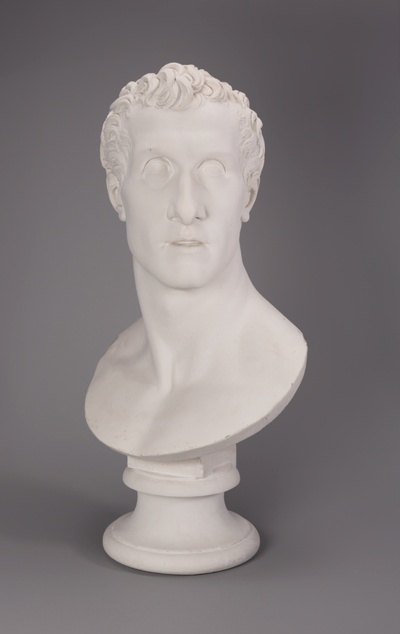
This is a marble sculpture of a young man's head and shoulders, known as a bust. It shows Paris, a shepherd from Greek mythology. The bust stands about 70 centimeters tall, roughly two feet three inches, and it sits on a tall base called a socle, which brings the whole piece to about 135 centimeters. Look first at the face. It is smooth, calm and idealized, meaning it shows a perfected beauty rather than a portrait of a real person. The head is turned to one side, as if he has just noticed something. He also wears a hat, a detail that marks him as a shepherd.
Begin with the turn of the head. Paris is caught in the act of turning to gaze at three goddesses, so walk around the bust and notice how the pose changes as you move. Next, study the expression on the face. It is gentle and a little sensuous, a word meaning appealing to the senses, and it sits alongside the clean, simple shapes of the forehead, nose and chin. Finally, find the hat on top of his head. It is the sign of his life as a shepherd, set above the polished face below.
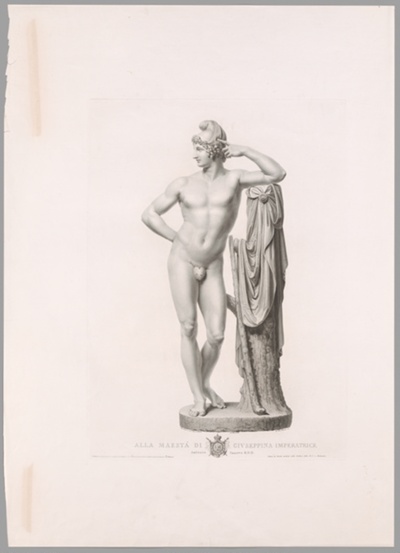
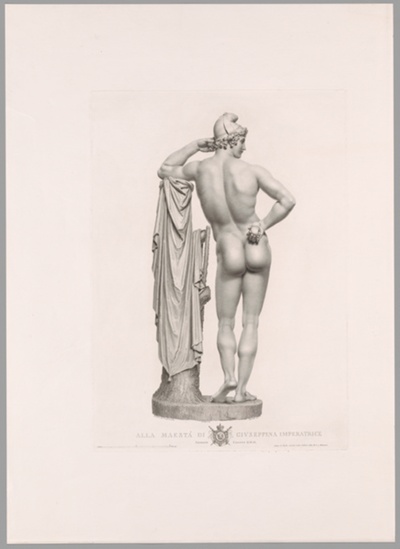
Antonio Canova, an Italian sculptor, carved this bust in 1809. He was enormously popular, and he often made copies or variations of his major works to meet the demand for them. At the time, he was working on a full-length statue of Paris for Empress Josephine of France. Alongside it, he carved this bust for his friend Antoine Quatremère de Quincy, a French critic and theorist. Quatremère wrote about Neoclassicism, the style that looked back to ancient Greek and Roman art, and he greatly influenced Canova's ideas about what art should be.
The story behind the bust is a famous one. The god Zeus asked Paris to judge which of three goddesses was the most beautiful: Hera, Athena or Aphrodite. Canova used this moment to create an ideal head, balancing pure geometric forms with a sensuous expression. Quatremère praised it for combining life, softness and chaste purity. Its popularity is clear from the records, which show that Canova made four full-length marble statues of Paris and at least seven busts. Before you leave, look again at the face and see whether you can find both the calm and the feeling in it.
This guide was written by AI from material published by Art Institute of Chicago. Licence: CC BY 4.0
Save this version (English · New to it · Medium) with all its audio, guide text and work image. It replaces the saved guide for this work and language.
Audio storage: about 40 MB per guide and 150 MB on this device. Audio expires 7 days after it is downloaded.
Save this work’s image and museum information on this device to read without a connection.
Ask in your own words. The answer comes from what the museum has written about the work, and says so when that does not hold it.
Image: Art Institute of Chicago, CC0