Cabinet
Carlo Bugatti · c. 1895 · Cleveland Museum of Art
What did you think?
Save this work’s image and museum information on this device to read without a connection.
Guide
Adjust the guideNew to it · Medium
Nobody has listened to this guide yet. Making it takes about twenty seconds, and after that anyone can hear it straight away.
From the museum
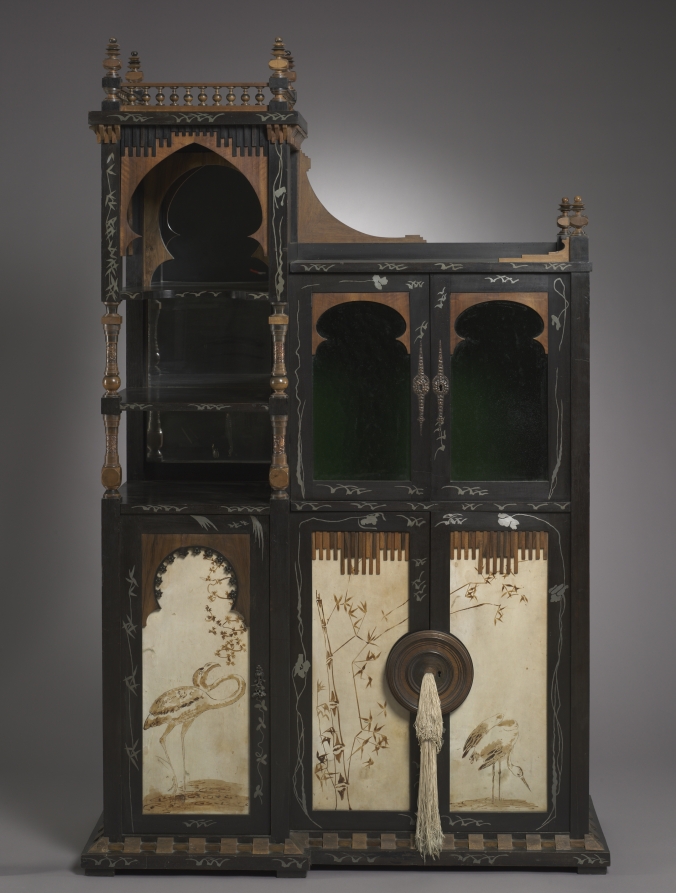
In both form and decoration this cabinet typifies the work of Carlo Bugatti. Asymmetrical, with a tower-like element at one side, there are Islamic-inspired ornaments throughout its design, notably the onion-shaped arches in the upper half of the cabinet. Japanese influence is also evident in the white metal inlays and in the sepia-painted parchment panels. The cabinet displays an extensive vocabulary of other decorative devices, including the partial ebonized frame, the turned wooden ornaments, metal reliefs, mirrored and green glass, and silk tassels. Despite their diversity, Bugatti organized all these elements into a coherent design. Carlo Bugatti's sons achieved illustrious careers of their own. Rembrandt Bugatti (1884-1916) became a celebrated sculptor, and Ettore Bugatti (1881-1947) manufactured luxurious automobiles and racing cars.
The museum’s own description, in English. Licence: CC0
Ask about this work
Ask in your own words. The answer comes from what the museum has written about the work, and says so when that does not hold it.
Details
- Maker
- Carlo Bugatti (Italian, 1856–1940)
- Date
- c. 1895
- Medium
- wood with metal inlays and painted parchment, glass doors and mirror
- Dimensions
- Overall: 224.5 x 141 x 55.3 cm (88 3/8 x 55 1/2 x 21 3/4 in.)
- Place of origin
- France
- Held by
- Cleveland Museum of Art, Cleveland · On view · 221 19th Century Decorative Arts
- Credit line
- Gift of Barry Friedman and Patricia Pastor, New York
Image: Cleveland Museum of Art, CC0