Chandelier
Augustus Welby Northmore Pugin · 1852 · Art Institute of Chicago
Guide
Adjust the guideNew to it · Medium
Looking for this guide.
From the museum
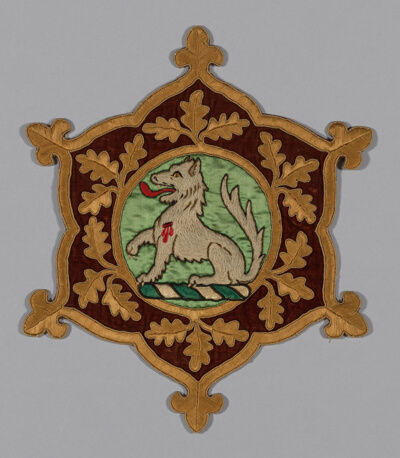
The motifs on this chandelier—including trefoils, quatrefoils, and scrolling foliage—were favorites of designer Augustus Welby Northmore Pugin, who was inspired by the ornamentation of medieval architecture. A leading figure in the Gothic Revival and a convert to Catholicism, Pugin believed that a return to Gothic design in both religious and secular settings would help England reconnect with what he viewed as the superior morals and society of the medieval period. Pugin introduced this style of chandelier, which combines the medieval Flemish tradition of brass casting with the technical capabilities of industrial manufacturing, at London’s Crystal Palace Exhibition of 1851. This particular piece, which is among his most monumental designs for domestic spaces, was commissioned by Henrietta Pole in 1853 for Aldenham Abbey (also known as Wall Hall) in Hertfordshire, England, where it remained for over a century. The coats of arms of her family and her husband, Sir William Stuart, hang between the lower branches.
The museum’s own description, in English. Licence: CC BY 4.0
What did you think?
Save this work’s image and museum information on this device to read without a connection.
Ask about this work
Ask in your own words. The answer comes from what the museum has written about the work, and says so when that does not hold it.
Details
- Maker
- Augustus Welby Northmore Pugin, English, 1812-1852, Manufactured by John Hardman and Company, Birmingham, England, founded 1838
- Date
- 1852
- Medium
- Brass and enamels
- Dimensions
- 304.8 × 238.8 cm (120 × 94 in.)
- Place of origin
- England
- Held by
- Art Institute of Chicago, Chicago · On view · Gallery 235
- Credit line
- Major Acquisition Fund; John H. and Neville Bryan Endowment Fund; Richard T. Crane Jr. Memorial Fund
Image: Art Institute of Chicago, CC0