Just a moment
Just a moment
Rembrandt van Rijn · 1653-c.1660 · Cleveland Museum of Art
A closer look, connecting key details with the work’s background.
Looking for this guide.
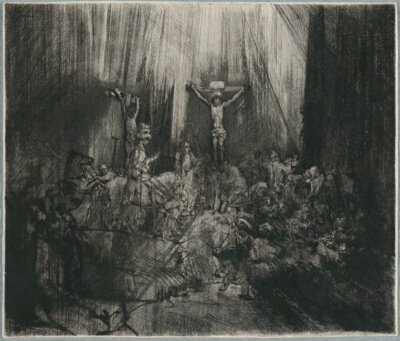
Rembrandt’s Christ Crucified Between the Two Thieves is executed entirely in drypoint. Because of the delicacy of the technique, the copper plate was worn after the artist printed about 40 impressions of the first three states. In order to continue using the plate, Rembrandt reworked it, changing the image somewhat. In this fourth state, slashing strokes obscure the spectators visible in the earlier version, creating a tenebrous setting that focuses attention on Christ bathed in celestial light. Although drypoint is an inherently linear medium, Rembrandt used it to obtain tonal qualities associated with painting. The blackness becomes an active force that threatens to extinguish the light of Christ—a literal illustration of the Evangelist Luke’s description of the event that brought "a darkness over all the earth." When he printed this impression, Rembrandt deliberately left ink on the printing plate, specifically on the left and right sides, essentially creating a unique work.
The museum’s own description, in English. Licence: CC0
Save this work’s image and museum information on this device to read without a connection.
Ask in your own words. The answer comes from what the museum has written about the work, and says so when that does not hold it.
Image: Cleveland Museum of Art, CC0