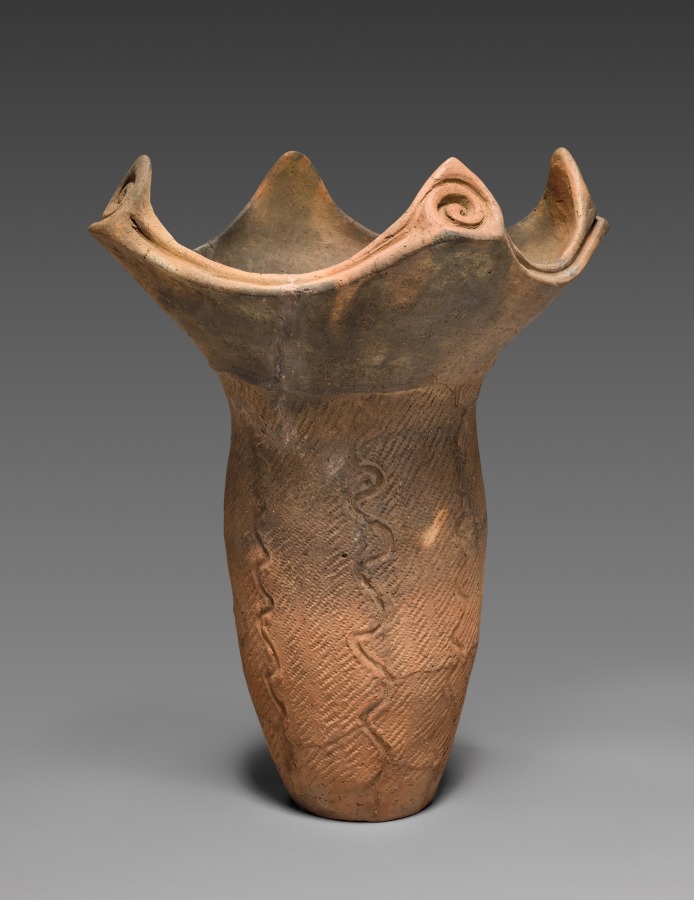
Deep Vessel
Japan, Jōmon period (c. 10,500–300 BCE) · c. 2500 BCE · Cleveland Museum of Art
What did you think?
Guide
Adjust the guideNew to it · Medium
Nobody has listened to this guide yet. Making it takes about twenty seconds, and after that anyone can hear it straight away.
From the museum
This cooking vessel was formed by piling coils of clay atop one another, smoothing and thinning the walls, and then adding surface decoration. Vertical incised squiggle lines as well as diagonal impressed cord patterns create texture. The mouth rises in four dramatic triangular forms, each with a coiled design inside. Jōmon, impressed rope patterns, are typical of vessels of this era, so archaeologists named the period after them.
The museum’s own description, in English. Licence: CC0
Ask about this work
Ask in your own words. The answer comes from what the museum has written about the work, and says so when that does not hold it.
Details
- Maker
- Japan, Jōmon period (c. 10,500–300 BCE)
- Date
- c. 2500 BCE
- Medium
- Earthenware with impressed and carved decoration
- Dimensions
- height: 44.7 cm (17 5/8 in.); Diameter: 36.8 cm (14 1/2 in.)
- Place of origin
- Japan
- Held by
- Cleveland Museum of Art, Cleveland · On view · 001A ArtLens Exhibition
- Credit line
- John L. Severance Fund
Image: Cleveland Museum of Art, CC0