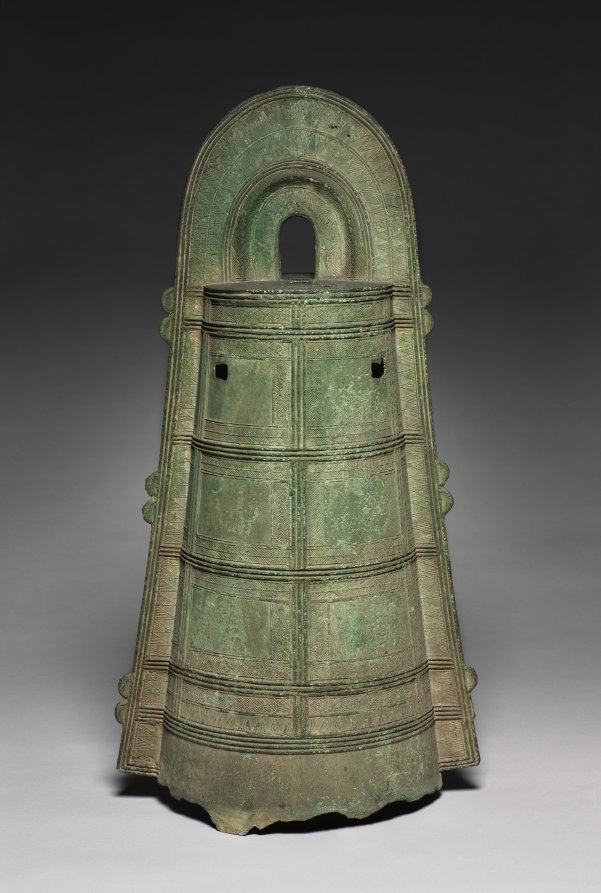
Dōtaku
Japan, Yayoi period (c. 300 BCE–300 CE) · 100–200 CE · Cleveland Museum of Art
What did you think?
Guide
Adjust the guideNew to it · Medium
Nobody has listened to this guide yet. Making it takes about twenty seconds, and after that anyone can hear it straight away.
From the museum
The flow of new peoples from Korea to Japan during the Yayoi period brought new technologies of bronze and iron casting. Similarly, the form of the dōtaku, or bronze bell, is thought to have originated in Korea. The original Korean prototypes—stout, thickly cast bells—were transformed in Japan into sculptural forms with sophisticated surface decoration. These dōtaku are often uncovered near burial sites paired with a metal spear or sword nearby, suggesting ceremonial importance.
The museum’s own description, in English. Licence: CC0
Ask about this work
Ask in your own words. The answer comes from what the museum has written about the work, and says so when that does not hold it.
Details
- Maker
- Japan, Yayoi period (c. 300 BCE–300 CE)
- Date
- 100–200 CE
- Medium
- cast bronze
- Dimensions
- Overall: 97.8 x 48.9 cm (38 1/2 x 19 1/4 in.)
- Place of origin
- Japan
- Held by
- Cleveland Museum of Art, Cleveland · On view · 235B Japanese
- Credit line
- Gift of Mrs. Arthur St. John Newberry
Image: Cleveland Museum of Art, CC0