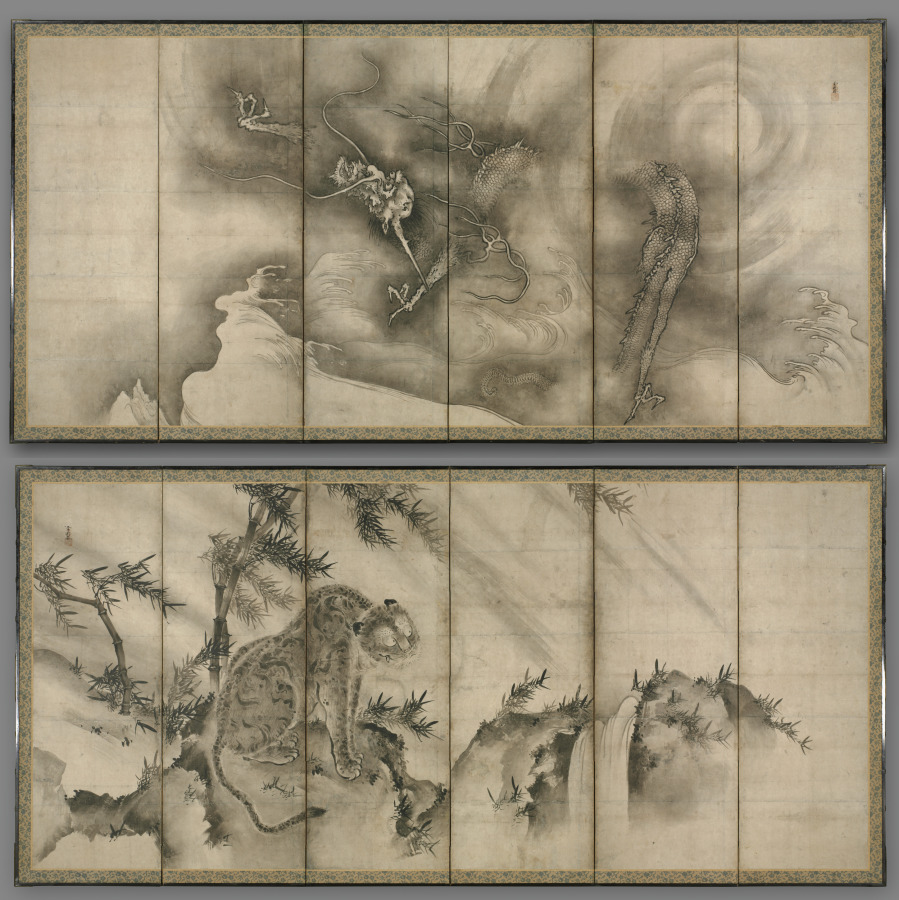
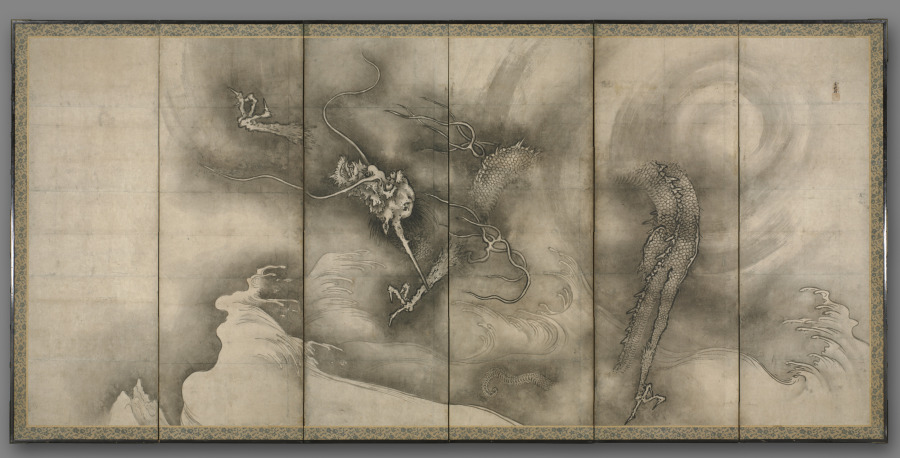
Dragon and Tiger
Sesson Shūkei · c. 1546–56 · Cleveland Museum of Art
Guide
Adjust the guideNew to it · Medium
Looking for this guide.
From the museum
In Chinese cosmology, the tiger's roar is said to produce wind. In Chinese paintings, the tiger is often shown with a dragon, who creates rain clouds. Together, they represent the balancing forces of the universe. Chinese presentations of the theme, often in hanging scroll format, provided the basic composition for the pair of screens to which this one belongs. Although the theme of this painting derives from Chinese philosophy and pictorial culture, Sesson's tiger is likely modeled after Korean prototypes of the Joseon period circulating in Japan.
The museum’s own description, in English. Licence: CC0
What did you think?
Save this work’s image and museum information on this device to read without a connection.
Ask about this work
Ask in your own words. The answer comes from what the museum has written about the work, and says so when that does not hold it.
Details
- Maker
- Sesson Shūkei (Japanese, c. 1492–c. 1577)
- Date
- c. 1546–56
- Medium
- One of a pair of six-panel folding screens; ink on paper
- Dimensions
- Painting: 157.3 x 339 cm (61 15/16 x 133 7/16 in.); Framed: 172.3 x 354 cm (67 13/16 x 139 3/8 in.)
- Place of origin
- Japan
- Held by
- Cleveland Museum of Art, Cleveland · Not on view
- Credit line
- Purchase from the J. H. Wade Fund
Image: Cleveland Museum of Art, CC0