Just a moment
Just a moment
Chimú · 1470-1532 · Art Institute of Chicago
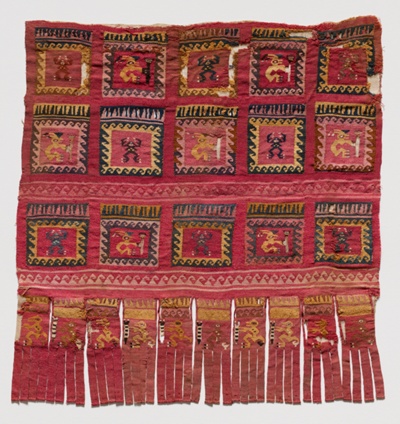
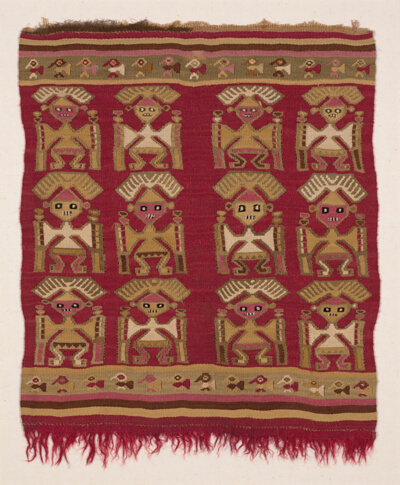
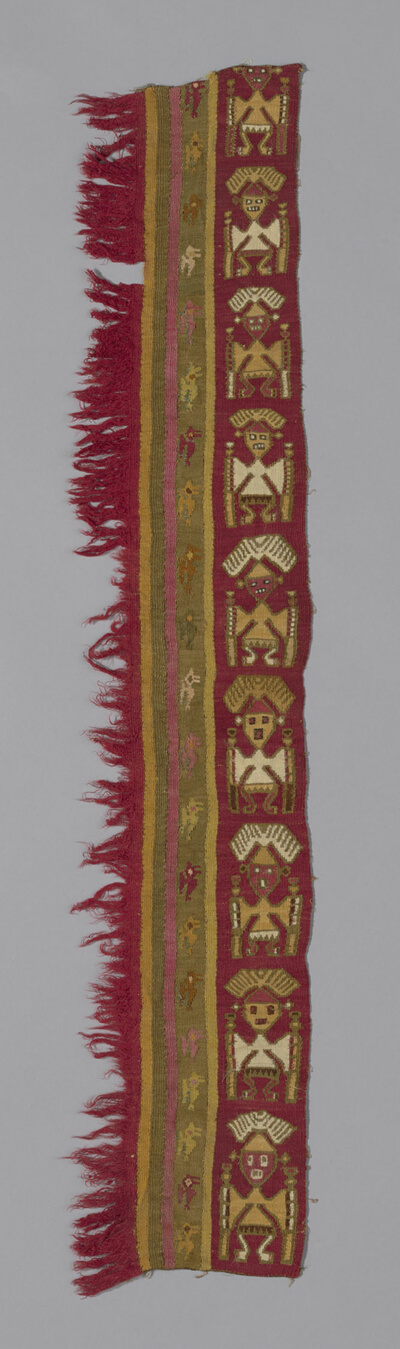
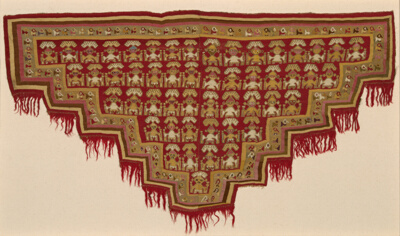
This is a tunic made by Chimú weavers in Peru, between 1470 and 1532. It is a little over eighty-five centimeters, or about thirty-three inches, across and nearly as tall. It was made as a sleeveless garment that would reach about to the knee. The base is plain cotton cloth, but you cannot see it. Thousands of brightly colored feathers cover every part of the surface. The feathers were knotted and stitched onto the cotton with thread. Across the feathers, you will find animal and bird figures, along with fish, all shown in a bold, simplified style.
Look across the surface for the creatures worked in feathers. The museum describes stylized felines, birds and fish. Stylized means the animals are simplified into clear, bold shapes rather than drawn the way they look in life. Try to pick out the cats first, then search for the birds and the fish among them. The subjects also include stepped shapes and triangles, so look for those blocky, angled forms in the patterns. Notice how the colors set each shape apart, even though every one is made from the same small feathers.
The Chimú weavers who made this tunic worked in northern Peru. The cotton cloth underneath is woven in the simplest way, called plain weave, where threads pass over and under one another. The feathers came from macaws, parrots, toucans, cotingas and tanagers. These birds live in the tropical forests of South America. To reach the weavers, the feathers had to be carried across the dangerous peaks of the Andes. That journey made them extremely rare and valuable. The maker then covered the cotton completely, one feather at a time, using knots and small stitches.
Because the feathers were so rare, only the most elite members of pre-Hispanic society could have owned a tunic like this. It would have served as a rich emblem of power, wealth and prestige. Like many textiles of its time, it was buried with its owner in an underground tomb on the southern coast of Peru. The dark, dry conditions there protected it, which is why its colors and bold shapes survive today. Look a little longer at the colors, and remember that they have lasted for centuries in the dark.
This guide was written by AI from material published by Art Institute of Chicago. Licence: CC BY 4.0
Save this version (English · New to it · Medium) with all its audio, guide text and work image. It replaces the saved guide for this work and language.
Audio storage: about 40 MB per guide and 150 MB on this device. Audio expires 7 days after it is downloaded.
Save this work’s image and museum information on this device to read without a connection.
Ask in your own words. The answer comes from what the museum has written about the work, and says so when that does not hold it.
Image: Art Institute of Chicago, CC0