Just a moment
Just a moment
Ancient Roman · 1st century · Art Institute of Chicago
A closer look, connecting key details with the work’s background.
Looking for this guide.
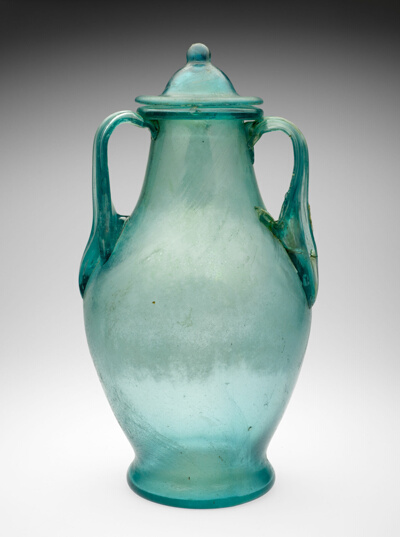
Initially affordable only among the wealthy, glass was used in ancient Rome as containers for oils, perfume, and tablewares. The variety of glass-making techniques reveals the changing tastes and fashions over the centuries. During the 1st century AD, cast glass was a novel form that was a luxury for the Roman household, but by the end of the century, the innovation of blown glass allowed for less labor-intensive and less expensive production, which meant people of lesser means could afford it. Blown glass became so popular it nearly supplanted ceramic and even bronze wares in the home. With the invention of glass blowing came the possibility of making molds to produce multiples, enabling mass production of popular designs. Whimsical shapes, like this date, enjoyed great popularity. While most molds were made of clay or plaster, it is likely that the mold for this flask was made from an actual dried date. Dates were not only a staple of the Mediterranean diet, used to sweeten food and wine, but were also a symbolic gift given at the New Year.
The museum’s own description, in English. Licence: CC BY 4.0
Save this work’s image and museum information on this device to read without a connection.
Ask in your own words. The answer comes from what the museum has written about the work, and says so when that does not hold it.
Image: Art Institute of Chicago, CC0