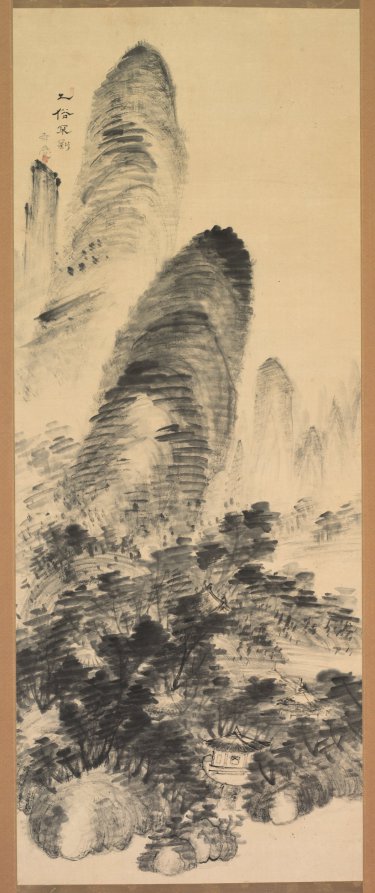
Forbidden to the Vulgar
Uragami Gyokudō · late 1800s-early 1900s · Cleveland Museum of Art
What did you think?
Guide
Adjust the guideNew to it · Medium
Nobody has listened to this guide yet. Making it takes about twenty seconds, and after that anyone can hear it straight away.
From the museum
Beneath looming peaks, an assortment of buildings is partially visible through the trees in this work. The artist, Uragami Gyokudō, was an esteemed player of the guqin, a Chinese seven-stringed instrument. At the age of 50, he abandoned his government post in Okayama in western Japan and took up painting in earnest. He traveled the country with his sons and ultimately settled in Kyoto, where he enjoyed a life of music, painting, and the companionship of scholars. Gyokudo painted in the Nanga style (literary men's school of painting), originally influenced by 18th-century Chinese painting.
The museum’s own description, in English. Licence: CC0
Ask about this work
Ask in your own words. The answer comes from what the museum has written about the work, and says so when that does not hold it.
Details
- Maker
- Uragami Gyokudō (Japanese, 1745–1820)
- Date
- late 1800s-early 1900s
- Medium
- hanging scroll; ink on paper
- Dimensions
- With mount: 67.2 cm (26 7/16 in.); Painting only: 134.6 x 51.1 cm (53 x 20 1/8 in.)
- Place of origin
- Japan
- Held by
- Cleveland Museum of Art, Cleveland · Not on view
- Credit line
- Mr. and Mrs. William H. Marlatt Fund
Image: Cleveland Museum of Art, CC0
