Just a moment
Just a moment
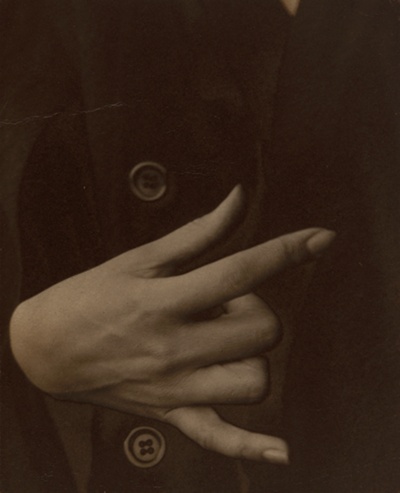
Alfred Stieglitz · 1919 · Art Institute of Chicago
This is a small photograph, about twenty-four centimeters high and nineteen wide. It was made in 1919 by Alfred Stieglitz. It shows the hands of the painter Georgia O'Keeffe, along with a thimble. A thimble is the small cap worn on a fingertip to push a needle through cloth when sewing. The picture is a palladium print, which means the image was formed on the paper with palladium, a metal, instead of the silver used in most photographs. The paper is only slightly larger than the image, so the margin around it is very narrow.
Alfred Stieglitz was an American who spent the first half of the twentieth century campaigning to have photography and modern art taken seriously. He founded a group called the Photo-Secession, then a magazine called Camera Work, and then a series of galleries. The best known, called 291, ran from 1908 until 1917. Georgia O'Keeffe's paintings were shown there, and she became his wife in 1924. Between 1917 and 1937 he took about five hundred photographs of her, in a search for objective truth and pure form.
Stieglitz felt that O'Keeffe's essence was not found in her head and face alone. Her torso, her feet, and above all her hands were just as expressive. So he built what is called a composite portrait, one portrait made from many separate pictures. Each photograph reveals her nature at a particular moment and can stand alone. Seen together, they show the many different selves of O'Keeffe. This picture is one piece of that larger portrait. Look at the hands a little longer, and ask what they tell you about her in this single moment.
This guide was written by AI from material published by Art Institute of Chicago. Licence: CC BY 4.0
Save this version (English · New to it · Medium) with all its audio, guide text and work image. It replaces the saved guide for this work and language.
Audio storage: about 40 MB per guide and 150 MB on this device. Audio expires 7 days after it is downloaded.
Save this work’s image and museum information on this device to read without a connection.
Ask in your own words. The answer comes from what the museum has written about the work, and says so when that does not hold it.
Image: Art Institute of Chicago, CC0