Just a moment
Just a moment
Ike Taiga · 1755/65 · Art Institute of Chicago
A closer look, connecting key details with the work’s background.
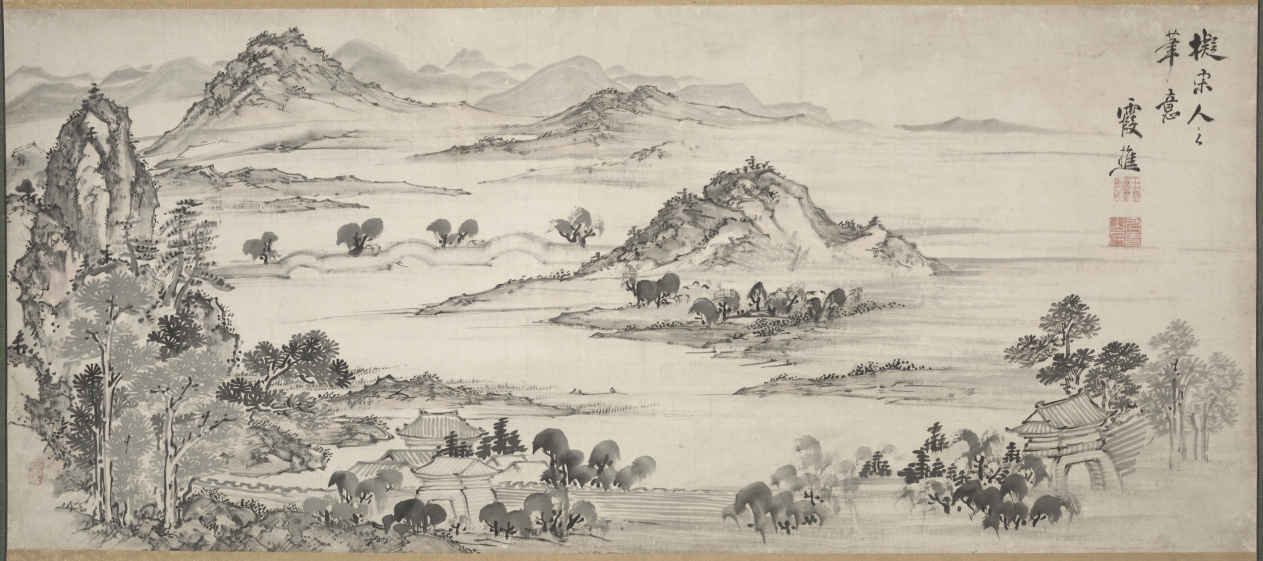
This is a hanging scroll, which is a painting mounted so it can be hung on a wall and rolled up for storage. It is made with ink on paper, and it is wider than it is tall: about 55 centimeters high and 123 centimeters across, or just over four feet wide. It shows pilgrims making offerings to the Jizo nun. She was a holy woman believed able to communicate with Jizo, a bodhisattva, which in Buddhism is a being who helps save others. Jizo was thought to have the power to save souls in the afterlife. The artist presents the scene like a snapshot of everyday life in Japan.
Look at the two areas of handwriting. On the right side, nineteen columns of text tell the story of the Jizo nun. The writer says he visited in early summer and describes her as thirty-seven years old. He adds that people of every rank come to worship at her gates. At the end of that text is the artist's signature, Mumei, which is one of his art names. On the left side, seven shorter columns hold a poem. It praises the nun and says the multitudes come to worship her. The writing is loose and informal, just like the painting.
Ike Taiga lived from 1723 to 1776, and this work dates from between 1755 and 1765. He was a master calligrapher, poet, and seal carver, which means he also carved the stamps artists use to sign their work. He was famous for finger painting and other odd techniques. Experts disagree about whether this is a finger painting, but it is clear he did not use a traditional brush. It may be a paper twist painting, made with scraps of twisted paper soaked in ink. The writing was done in a quick, cursive hand to match the spontaneity of the picture.
Taiga was called a revolutionary who gave new life to Japanese painting traditions in the eighteenth century. Intellectuals in Kyoto were then admiring nanga, a style of ink painting inspired by China. Taiga added a purely Japanese outlook and a sense of humor to it. This scroll shows his own view of the world around him, as a crowd gathers around a holy woman. Spend a little longer on the marks themselves. Notice how the lines look different from brushstrokes, and how the writing on both sides seems to move with the same loose energy.
This guide was written by AI from material published by Art Institute of Chicago. Licence: CC BY 4.0
Save this version (English · New to it · Medium) with all its audio, guide text and work image. It replaces the saved guide for this work and language.
Audio storage: about 40 MB per guide and 150 MB on this device. Audio expires 7 days after it is downloaded.
Save this work’s image and museum information on this device to read without a connection.
Ask in your own words. The answer comes from what the museum has written about the work, and says so when that does not hold it.
Image: Art Institute of Chicago, CC0