Hercules Killing Cacus
Guide
Adjust the guideNew to it · Medium
Looking for this guide.
From the museum
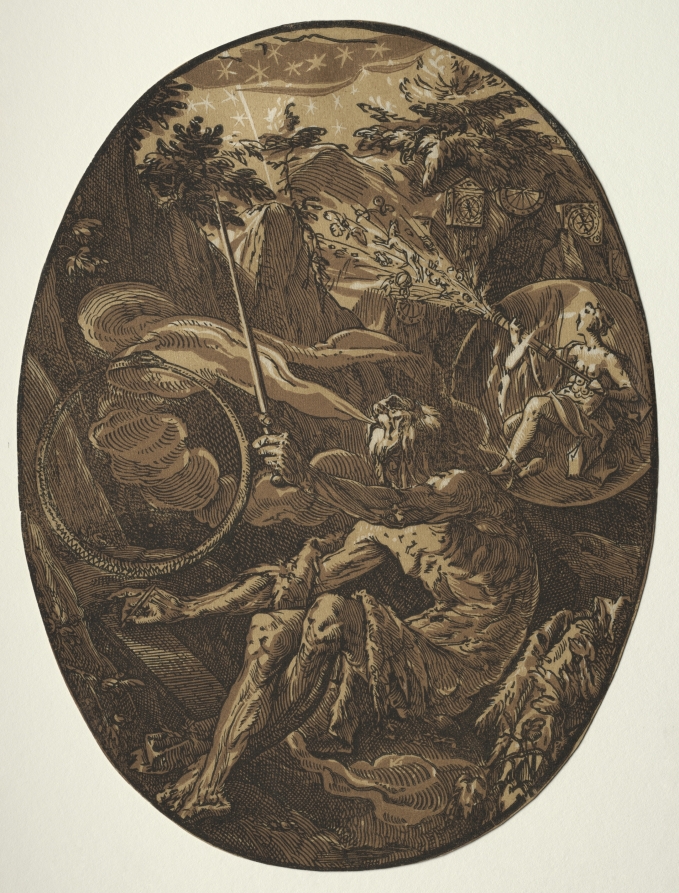
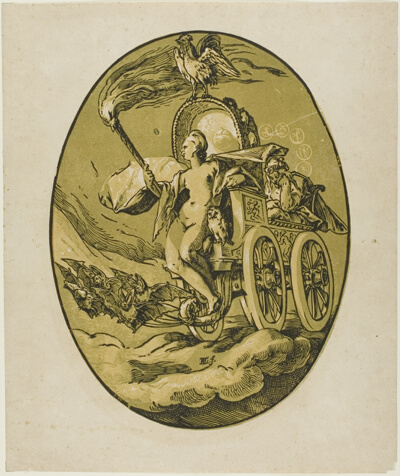
To make a chiaroscuro woodcut, an artist uses a separate woodblock for printing each different color of ink. Often, as was the case for both of these prints, the image was rendered primarily in a line block, usually in black. The additional colors—together with the color of the paper itself—provide more definition to the forms and more dramatic light effects. The virtuoso graphic artist Hendrick Goltzius used the chiaroscuro woodcut technique to great effect in his depiction of Hercules completing the 10th of his 12 labors: the capture of the cattle of Geryon. To accomplish this feat, he had to vanquish the giant Cacus. Goltzius shows the moment just before Hercules violently clubs the giant, which is made especially dramatic by the vivid conjunction of yellow and green. Although Goltzius's advances in line engraving found many followers, few artists pursued his equally original exploration of chiaroscuro woodcuts printed from one line block and multiple tone blocks. The largest, and one of the earliest of the chiaroscuro woodcuts from Goltzius's workshop, this dramatic print is also the only one to have a date cut into the block. Here Hercules slays Cacus, a cattle thief, in his cave in the Aventine hills.
The museum’s own description, in English. Licence: CC BY 4.0
What did you think?
Save this work’s image and museum information on this device to read without a connection.
Ask about this work
Ask in your own words. The answer comes from what the museum has written about the work, and says so when that does not hold it.
Details
- Maker
- Hendrick Goltzius, Dutch, 1558-1617
- Date
- 1588
- Medium
- Chiaroscuro woodcut from three blocks in black, yellow and olive-green, on ivory laid paper
- Dimensions
- Image/plate/sheet trimmed to platemark: 41 × 33.2 cm (16 3/16 × 13 1/8 in.)
- Place of origin
- Netherlands
- Held by
- Art Institute of Chicago, Chicago · Not on view
- Credit line
- Gift of Alfred E. Hamill
Image: Art Institute of Chicago, CC0