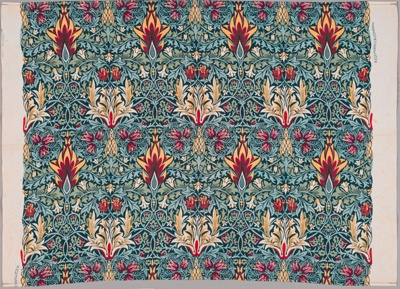
Honeysuckle
William Morris · Early 20th century · Cleveland Museum of Art
Guide
Adjust the guideNew to it · Medium
Nobody has listened to this guide yet. Making it takes about twenty seconds, and after that anyone can hear it straight away.
From the museum
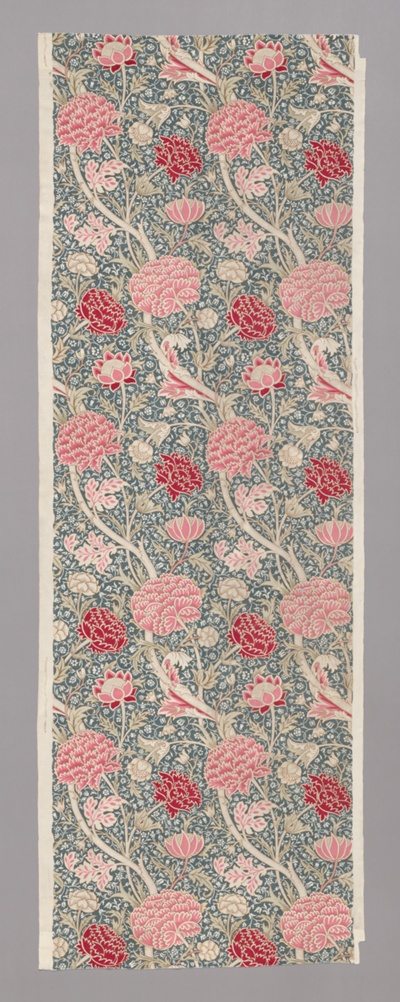
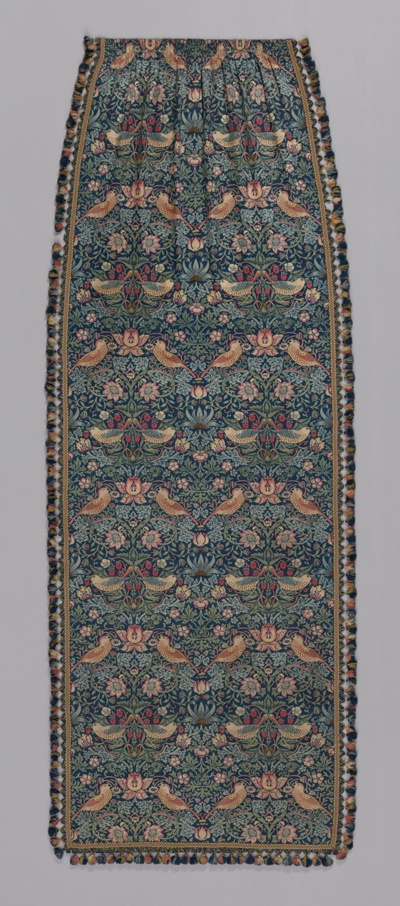
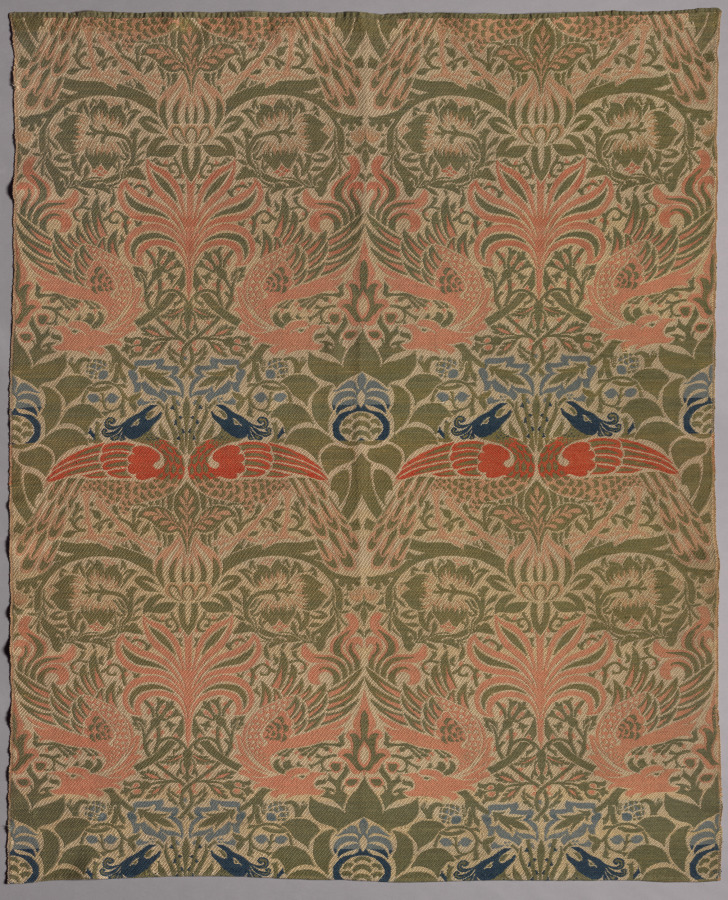
William Morris’s daughter May called Honeysuckle “the most truly Morrisian in character of all his pattern-making . . . the most mysterious and poetic—the very symbol of a garden tangle.” Like many Morris textiles from this period, Honeysuckle has a mirrored pattern. At 29 3/4 inches high and 34 3/4 inches wide, this repeat was unusually broad, spanning almost the entire width of the loom. Morris believed that large patterns were more restful to the eye than small patterns, even when used to decorate modestly sized rooms. Designs from this period are a testament to the delight he took in his garden at Kelmscott Manor; he favored the charm of native English flowers above exotic specimens.
The museum’s own description, in English. Licence: CC0
What did you think?
Save this work’s image and museum information on this device to read without a connection.
Ask about this work
Ask in your own words. The answer comes from what the museum has written about the work, and says so when that does not hold it.
Details
- Maker
- William Morris (British, 1834–1896)
- Date
- Early 20th century
- Medium
- plain weave linen, printed
- Dimensions
- Overall: 87 x 90.5 cm (34 1/4 x 35 5/8 in.)
- Place of origin
- England
- Held by
- Cleveland Museum of Art, Cleveland · Not on view
- Credit line
- Gift of Mrs. Henry Chisholm
Image: Cleveland Museum of Art, CC0