Just a moment
Just a moment
John Henry Twachtman · c. 1889 · Art Institute of Chicago
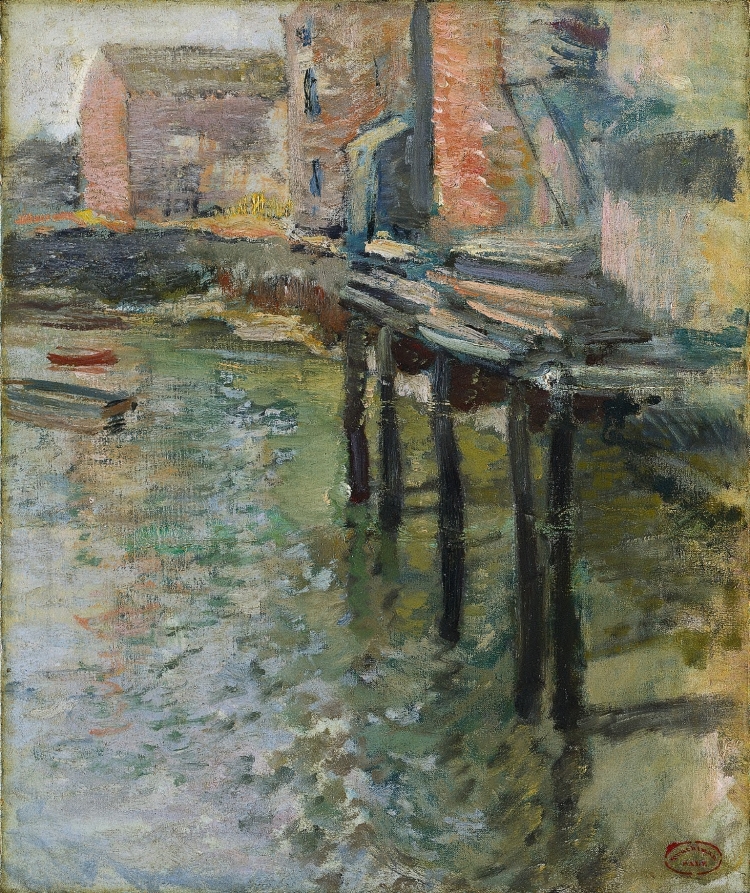
This is a winter landscape in oil paint on canvas, a little under two and a half feet wide and almost as tall, so the shape is close to a square. It shows a frozen landscape near the home of the American painter John Henry Twachtman in Greenwich, Connecticut. Snow and ice meet open water, and the whole scene is painted in soft, quiet colors. Nothing in it is busy or dramatic. Take a moment to let your eye wander across the surface, and notice how calm the picture feels, even though winter is usually thought of as bare and empty.
Look first at the edges where the snow and ice meet the water. Those edges are not straight. They sweep in long, winding curves, and they give the picture a sense of gentle movement, as if something is slowly flowing through the stillness. Next, look closely at the paint on the snowy ground. It is laid on thickly, in many layers, and the buildup of paint echoes the way snow gathers and settles on frozen earth. If you can, step close and see how the surface itself feels heavy and soft at once.
John Henry Twachtman painted this around 1889. In the last ten years of his life he often chose the landscape around his home in Greenwich, Connecticut, as his subject, and this view comes from that place. Many artists treated winter as a bleak, barren season. Twachtman did not. He liked to paint the beauty of frozen ground. The work is oil on canvas, and it belongs to the style called Impressionism, which is known for capturing the look of a scene through loose, visible touches of paint rather than fine detail.
Twachtman believed that frozen terrain encouraged contemplation, meaning quiet thought, and regeneration, meaning a sense of being renewed. For him, winter was not an ending. He is also remembered for saying that nature is never more lovely than when it is snowing. This painting puts that belief into practice. Its balanced, harmonious arrangement invites you to slow down. Before you move on, follow one of the curving edges of snow slowly from one side of the canvas to the other, and see where it leads your eye.
This guide was written by AI from material published by Art Institute of Chicago. Licence: CC BY 4.0
Save this version (English · New to it · Medium) with all its audio, guide text and work image. It replaces the saved guide for this work and language.
Audio storage: about 40 MB per guide and 150 MB on this device. Audio expires 7 days after it is downloaded.
Save this work’s image and museum information on this device to read without a connection.
Ask in your own words. The answer comes from what the museum has written about the work, and says so when that does not hold it.
Image: Art Institute of Chicago, CC0