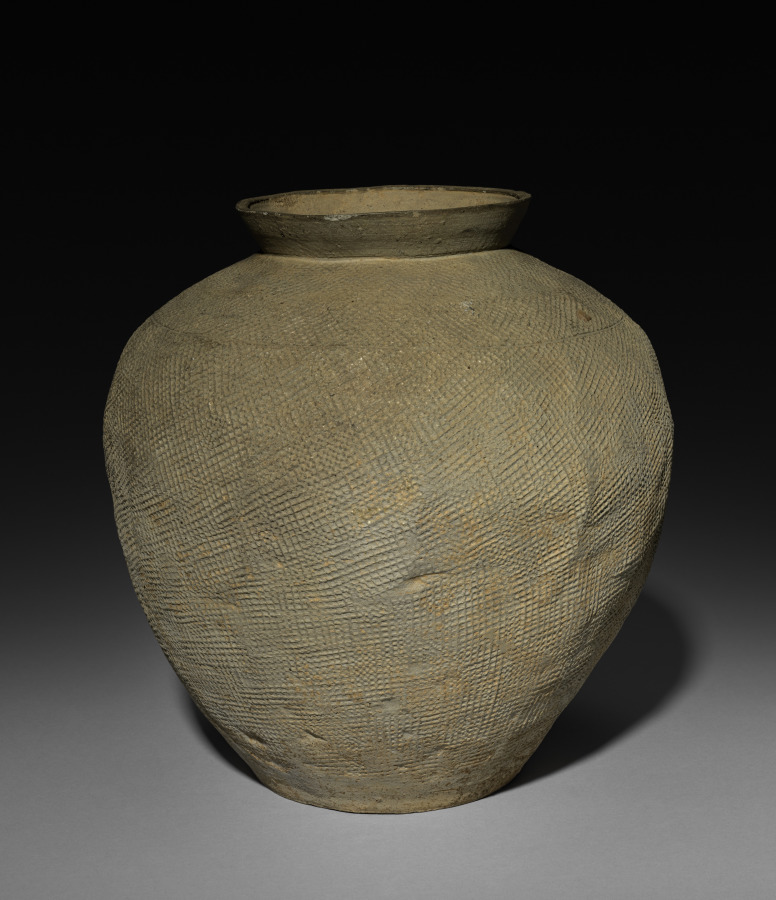
Jar
China, Hunan province, reportedly Changsha, Eastern Zhou dynasty (770–256 BCE), Warring States period (475–221 BCE) · 481–221 BCE · Cleveland Museum of Art
What did you think?
Save this work’s image and museum information on this device to read without a connection.
Guide
Adjust the guideNew to it · Medium
Nobody has listened to this guide yet. Making it takes about twenty seconds, and after that anyone can hear it straight away.
From the museum
Bronze Age potters customarily used patterned wooden paddles to smooth the ridges of their coil-built wares. Because such early pots were beaten repeatedly and randomly while still in the leather-hard state, the paddles did not leave isolated, self-contained patterns, but an overall surface texture.
The museum’s own description, in English. Licence: CC0
Ask about this work
Ask in your own words. The answer comes from what the museum has written about the work, and says so when that does not hold it.
Details
- Maker
- China, Hunan province, reportedly Changsha, Eastern Zhou dynasty (770–256 BCE), Warring States period (475–221 BCE)
- Date
- 481–221 BCE
- Medium
- earthenware with stamped decoration
- Dimensions
- Diameter of mouth: 12.8 cm (5 1/16 in.); Overall: 25.7 cm (10 1/8 in.)
- Place of origin
- China
- Held by
- Cleveland Museum of Art, Cleveland · Not on view
- Credit line
- Purchase from the J. H. Wade Fund
Image: Cleveland Museum of Art, CC0