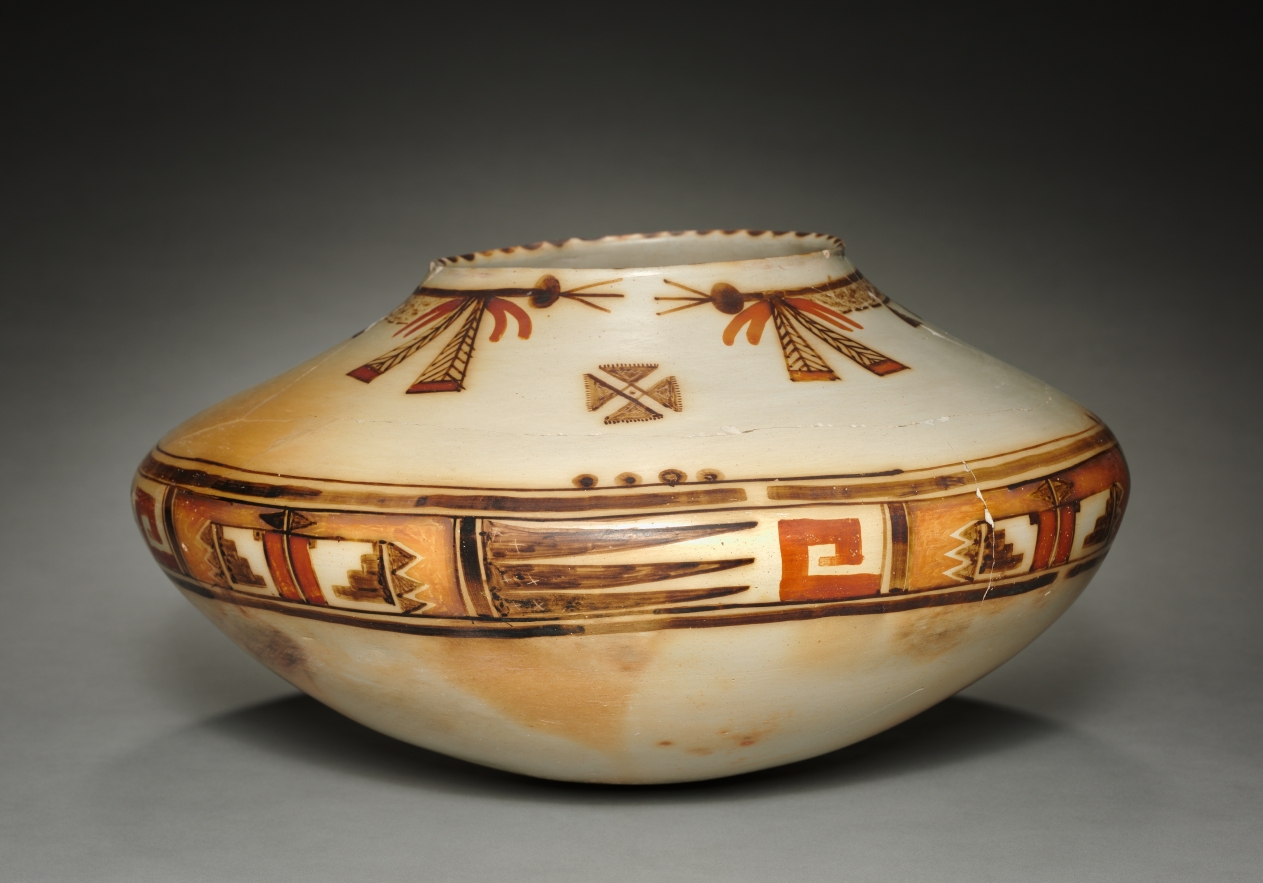
Jar
Native North America, Southwest, Ancestral Pueblo, Sikyatki style · 1400–1600 · Cleveland Museum of Art
What did you think?
Save this work’s image and museum information on this device to read without a connection.
Guide
Adjust the guideNew to it · Medium
Nobody has listened to this guide yet. Making it takes about twenty seconds, and after that anyone can hear it straight away.
From the museum
Ancient Sikyatki ceramics are noted for their large, distinctive shapes, meticulously stone-polished surfaces, thin walls that “ring” when tapped, and wide variety of reds and oranges, a contrast to earlier preferences for black and white. These artistically and technically inventive vessels are ancestral to modern Hopi ceramics, having developed in the area where Hopi communities live today. The Hopi regard a mottled orange color as a sign that the pot emerged from firing with life and spirit; the vessel’s “voice” is a bell-like tone that tapping produces. Such concepts likely have roots in the ancient past.
The museum’s own description, in English. Licence: CC0
Ask about this work
Ask in your own words. The answer comes from what the museum has written about the work, and says so when that does not hold it.
Details
- Maker
- Native North America, Southwest, Ancestral Pueblo, Sikyatki style
- Date
- 1400–1600
- Medium
- Ceramic, slip
- Dimensions
- Overall: 21.2 x 38.8 cm (8 3/8 x 15 1/4 in.)
- Place of origin
- Native North America
- Held by
- Cleveland Museum of Art, Cleveland · Not on view
- Credit line
- Purchase from the J. H. Wade Fund
Image: Cleveland Museum of Art, CC0