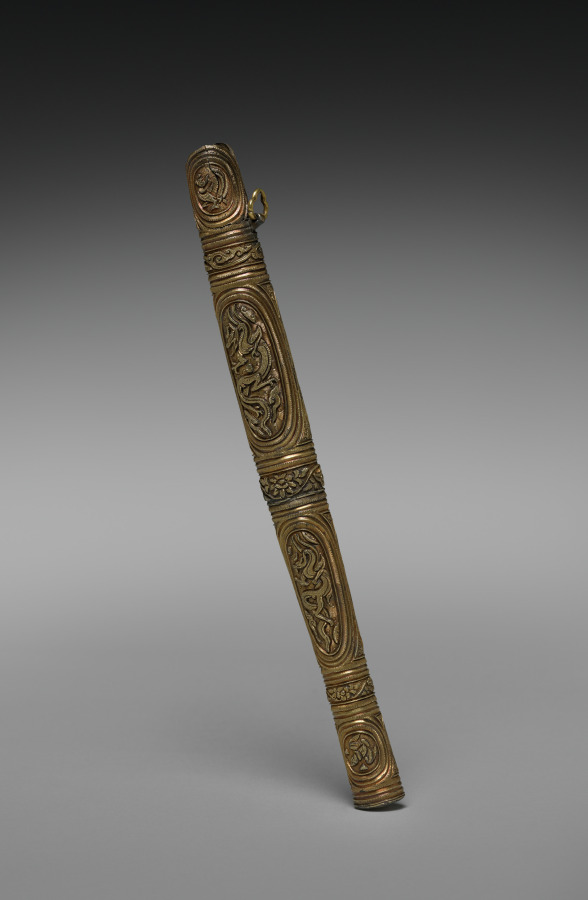
Knife Sheath
Korea, Goryeo dynasty (918–1392) · 1100s · Cleveland Museum of Art
What did you think?
Guide
Adjust the guideNew to it · Medium
Nobody has listened to this guide yet. Making it takes about twenty seconds, and after that anyone can hear it straight away.
From the museum
Made by rolling a flat piece of silver plate, this knife sheath is decorated on each side with oval panels, including two larger middle panels showing an image of rising dragons with ring-punched scales. The circular upper panels bear the image of seated phoenixes. The flat bottom is engraved with a pair of fish, symbolizing harmonious unity. The trefoil-shaped ring attached to the tip of the sheath allows a string to connect it as a pendant to a belt. In medieval Korea, a miniature sheath such as this was considered an important fashion item, especially for elite members of the ruling class. This 12th-century silver-gilt knife sheath is meant to be a pendent to a belt as a luxury ornament.
The museum’s own description, in English. Licence: CC0
Ask about this work
Ask in your own words. The answer comes from what the museum has written about the work, and says so when that does not hold it.
Details
- Maker
- Korea, Goryeo dynasty (918–1392)
- Date
- 1100s
- Medium
- Gilt silver (body) and brass (trefoil-shaped ring)
- Dimensions
- length: 21.7 cm (8 9/16 in.)
- Place of origin
- Korea
- Held by
- Cleveland Museum of Art, Cleveland · On view · 003 Special Exhibition Hall
- Credit line
- Purchase from the J. H. Wade Fund
Image: Cleveland Museum of Art, CC0