Just a moment
Just a moment
Clara Driscoll · By 1906 · Art Institute of Chicago
A closer look, connecting key details with the work’s background.
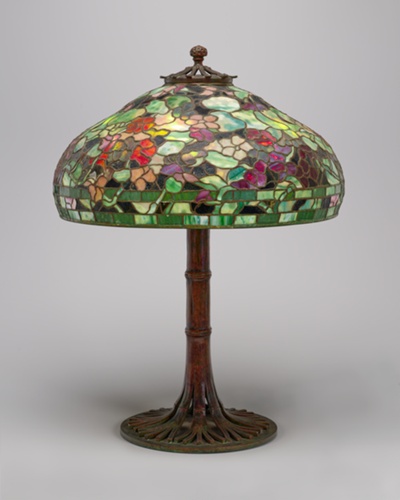
This is a table lamp made of glass and bronze, and it is a big one, measuring about 34 inches by 22 and a half inches. Dragonflies are the subject, and they cover the shade, the glowing glass hood at the top. The glass is called Favrile, which is opalescent. That means it has a soft, milky shimmer, a little like an opal gemstone. Below the shade sits a bronze and glass base, decorated with mosaic and turtleback glass. Start with the shade, where the insects gather.
Look first at the lower edge of the shade. The bodies of the insects are placed right along that bottom rim, and this is one of the features that distinguishes this lamp from other dragonfly lamps. Next, search the shade for the glass cabochons. A cabochon is a piece of glass or stone shaped smooth and rounded, rather than flat or cut with facets. Then lower your eyes to the base. Its mosaic is a surface built from many small pieces. Notice how it differs from the shade above.
Louis Comfort Tiffany was the artistic director of Tiffany Studios in Corona, New York. He approved every pattern, but he made relatively few lamps himself. This shade and base were likely the work of Clara Driscoll, who headed the Women's Glass Cutting Department. She began working for Tiffany in 1888 and designed most of the firm's lamps before leaving in 1908 or 1909. She created at least eight dragonfly shades. This lamp was made by 1906, and it stands out for its large size, its glass cabochons, and those insect bodies along the lower edge.
Lamps became the form for which Tiffany is most famous. Tiffany Studios mass-produced these shades and bases, yet it varied the colors of each one to heighten the sense of handcraftsmanship. So no two lamps look quite alike. This daring dragonfly design became one of the firm's most popular, and it stayed in production through 1924. Before you move on, look once more along the lower edge of the shade, and follow how the dragonflies' bodies sit there.
This guide was written by AI from material published by Art Institute of Chicago. Licence: CC BY 4.0
Save this version (English · New to it · Medium) with all its audio, guide text and work image. It replaces the saved guide for this work and language.
Audio storage: about 40 MB per guide and 150 MB on this device. Audio expires 7 days after it is downloaded.
Save this work’s image and museum information on this device to read without a connection.
Ask in your own words. The answer comes from what the museum has written about the work, and says so when that does not hold it.
Image: Art Institute of Chicago, CC0