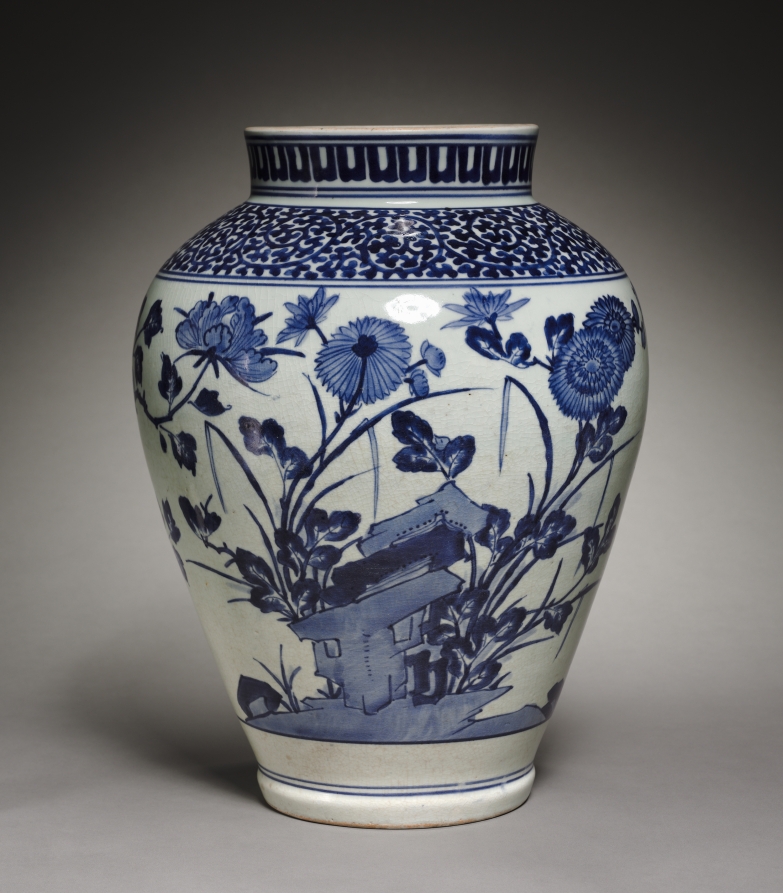
Large Jar with Peonies, Orchids, and Chrysanthemums
Japan, Edo period (1615–1868) · late 1600s · Cleveland Museum of Art
What did you think?
Guide
Adjust the guideNew to it · Medium
Nobody has listened to this guide yet. Making it takes about twenty seconds, and after that anyone can hear it straight away.
From the museum
Spring peonies, summer orchids, and autumn chrysanthemums bloom at once amid garden rocks. These underglaze blue motifs were inspired by similar designs on Chinese ceramics made for export to Europe. In the early 1600s, Korean potters in Japan discovered kaolin, the clay essential for porcelain production. At the same time, political turmoil in China following the collapse of the Ming dynasty (1368–1644) disrupted Chinese exports. Together, these circumstances created an opportunity for Japan to supply ceramics to the European market. Careful study of Chinese prototypes shaped the work of Japanese ceramists for both domestic and overseas audiences. This design shows the changing of the seasons: one side depicts a peony blossom in the spring, and the other side continues with chrysanthemums and an orchid in the autumn.
Ask about this work
Ask in your own words. The answer comes from what the museum has written about the work, and says so when that does not hold it.
Details
- Maker
- Japan, Edo period (1615–1868)
- Date
- late 1600s
- Medium
- Porcelain with underglaze blue decoration (Imari ware)
- Dimensions
- Diameter: 30.5 cm (12 in.); height: 40.1 cm (15 13/16 in.)
- Place of origin
- Japan
- Held by
- Cleveland Museum of Art, Cleveland · On view · 235A Japanese
- Credit line
- Severance and Greta Millikin Collection
Image: Cleveland Museum of Art, CC0