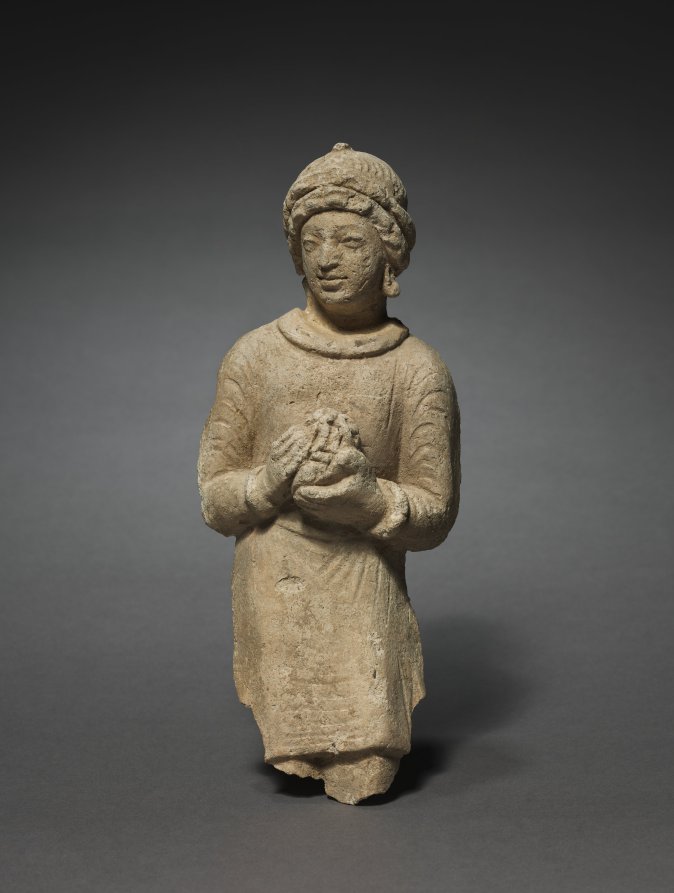
Layman bearing offerings
Afghanistan, Hadda, probably Tape Shotor · c. 300 CE · Cleveland Museum of Art
What did you think?
Guide
Adjust the guideNew to it · Medium
Nobody has listened to this guide yet. Making it takes about twenty seconds, and after that anyone can hear it straight away.
From the museum
The Buddhist monasteries at Hadda were famous internationally until their destruction by fire in the 800s CE. One thousand years later, a British explorer named Charles Masson (1800–1853) documented the site and collected many sculptures from the ruins that are now in the British Museum in London. French archaeologists carried out systematic excavations between 1926 and 1929. They brought many sculptures to the National Museum of Asian Art, Guimet, in Paris. Some sculptures entered other museum and private collections around the world. In the 1970s, Afghan archaeologists continued to document the Buddhist sites of Hadda and brought many more sculptures to the National Museum of Afghanistan in Kabul. The Buddhist community (sangha) consists of both monks and laypeople who brought wealth to support the monasteries at Hadda.
The museum’s own description, in English. Licence: CC0
Ask about this work
Ask in your own words. The answer comes from what the museum has written about the work, and says so when that does not hold it.
Details
- Maker
- Afghanistan, Hadda, probably Tape Shotor
- Date
- c. 300 CE
- Medium
- stucco with mother-of-pearl inlay
- Dimensions
- Overall: 25.3 x 9 x 5 cm (9 15/16 x 3 9/16 x 1 15/16 in.)
- Place of origin
- Afghanistan
- Held by
- Cleveland Museum of Art, Cleveland · On view · 001A ArtLens Exhibition
- Credit line
- Edward L. Whittemore Fund
Image: Cleveland Museum of Art, CC0