Just a moment
Just a moment
Piet Mondrian · 1921 · Art Institute of Chicago
A closer look, connecting key details with the work’s background.
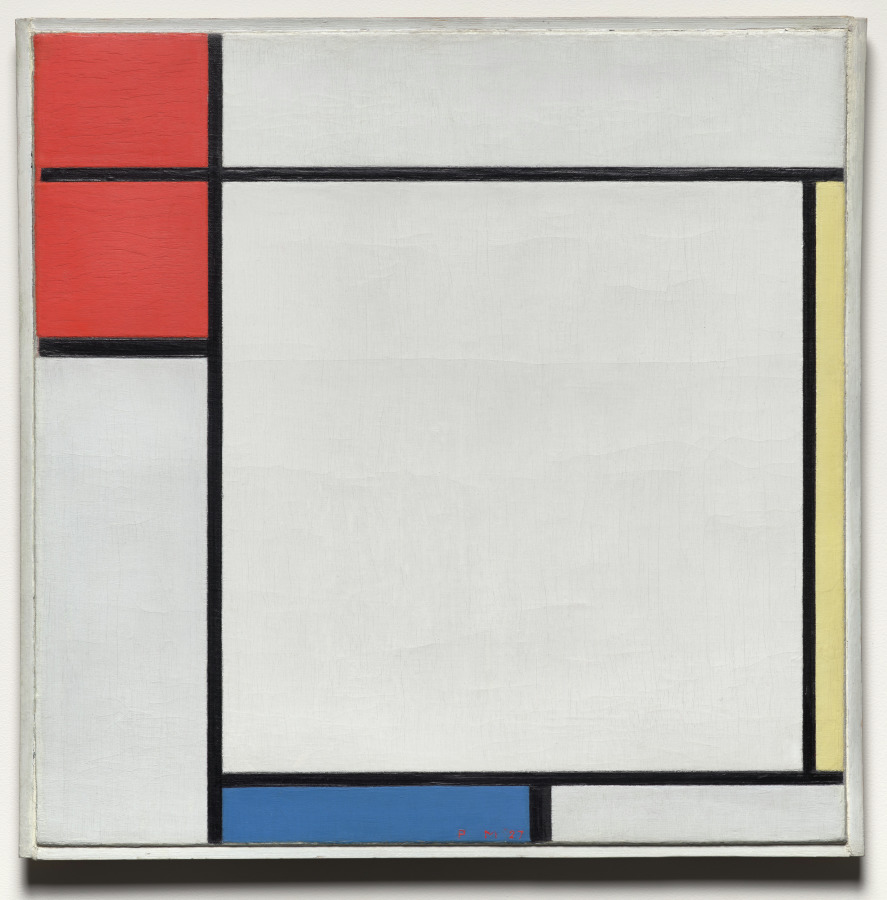
This is a square painting, sixty centimeters on each side, about two feet, made with oil paint on canvas. But it is not hung the way a square usually is. It is turned so that one corner points up and another points down, like a diamond. The word lozenge in the title simply means a diamond shape. Across the surface runs a grid of black lines, holding patches of yellow, blue, red, and gray, along with white. Because the canvas is tilted, its edges run on slants rather than straight up and down.
Look first at the black lines. Their squared-off corners close the colored shapes in, a little like fences around each patch. Then find the blue area and look just above it. There, a single line behaves differently. It runs all the way to the slanted edge of the canvas, as if it keeps going out into the room. Move your eyes back and forth between the lines that seem to hold things in and this one line that seems to leave.
Piet Mondrian was a Dutch painter, born in 1872, who made this work in 1921. He belonged to De Stijl, which means the Style, a revolutionary international movement. He argued that the straight line tells the truth. That makes the tilted canvas a surprise, since turning a square this way makes its edges into diagonals. Rotating the canvas let him return to a question he explored throughout his career: how the contents of a painting relate to whatever contains them.
The painting asks whether a picture must stop at its edges. Most of the black lines suggest enclosure, while one suggests extension beyond the canvas. Mondrian took this idea to the wall itself. He hung diagonal paintings well above eye level, so that they would invoke the full expanse of the wall around them. Look once more at the single line above the blue area, follow it to the slanted edge, and imagine it carrying on across the wall.
This guide was written by AI from material published by Art Institute of Chicago. Licence: CC BY 4.0
Save this version (English · New to it · Medium) with all its audio, guide text and work image. It replaces the saved guide for this work and language.
Audio storage: about 40 MB per guide and 150 MB on this device. Audio expires 7 days after it is downloaded.
Save this work’s image and museum information on this device to read without a connection.
Ask in your own words. The answer comes from what the museum has written about the work, and says so when that does not hold it.
Image: Art Institute of Chicago, CC0