Mère Grégoire
Gustave Courbet · 1855, reworked 1857–59 · Art Institute of Chicago
Guide
4 chapters · about 2 minAdjust the guideNew to it · Medium
A woman in modest, tidy clothing sits behind a marble-topped counter, looking out at us. This is an oil painting on canvas, about four feet tall, so the figure is close to life-sized. Coins lie scattered across the counter in front of her. Her right hand rests on a ledger, a book for recording money. Under her other hand is a small bell. She holds a flower in her raised hand, as if she is about to offer it to someone standing on our side of the counter. It feels like we have just walked in.
Start at the bottom of the painting, where the coins are spread across the marble. They tell us that business is being done. Then look just above them at her right hand, which rests on the ledger. Under her other hand, find the small bell. It was used to call the women who worked for her. Last, lift your eyes to the flower she holds. Its petals are blue, white, and red, the colors of the French flag. A flower is a traditional sign of love, and here it seems to be offered to the unseen customer.
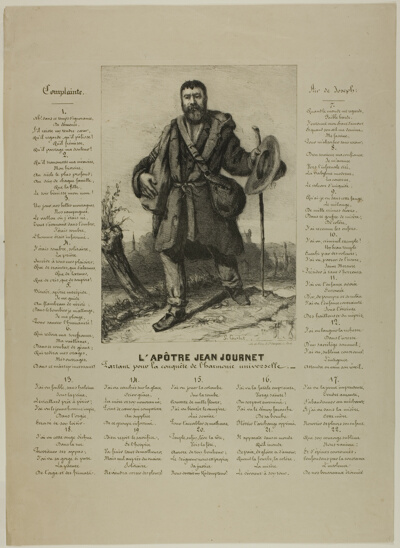
Gustave Courbet began this painting in 1855 as a simple head on a wide, horizontal canvas. Between 1857 and 1859 he made the canvas larger and turned it into the elaborate scene we see now, with the counter, the coins, and the objects on it. His subject came from a popular song of the 1820s by the French lyricist Pierre-Jean de Béranger. In the song, Madame Grégoire runs a brothel. Béranger often wrote ribald, cheeky lyrics, and Courbet borrowed his character, then dressed her in surprisingly demure clothes.
Béranger fiercely opposed the monarchy, and Courbet followed him as a dissident, someone who speaks out against those in power. When Courbet began this picture, the government of the Second Empire was harshly attacking Béranger's songs to limit free expression. Painting his Madame Grégoire, with a flower in the colors of the French flag, may have been a protest against that censorship and against the regime itself. She becomes a heroine of freedom in life and love. Look once more at the flower, and at how calmly she offers it.
This guide was written by AI from material published by Art Institute of Chicago. Licence: CC BY 4.0
Save this version (English · New to it · Medium) with all its audio, guide text and work image. It replaces the saved guide for this work and language.
Audio storage: about 40 MB per guide and 150 MB on this device. Audio expires 7 days after it is downloaded.
What did you think?
Save this work’s image and museum information on this device to read without a connection.
Ask about this work
Ask in your own words. The answer comes from what the museum has written about the work, and says so when that does not hold it.
Details
- Maker
- Gustave Courbet (French, 1819–1877)
- Date
- 1855, reworked 1857–59
- Medium
- Oil on canvas
- Dimensions
- 129 × 97.5 cm (50 3/4 × 38 3/8 in.); Framed: 168 × 137.2 × 16.2 cm (66 1/8 × 54 × 6 3/8 in.)
- Place of origin
- France
- Held by
- Art Institute of Chicago, Chicago · On view · Gallery 222
- Credit line
- Wilson L. Mead Fund
Image: Art Institute of Chicago, CC0