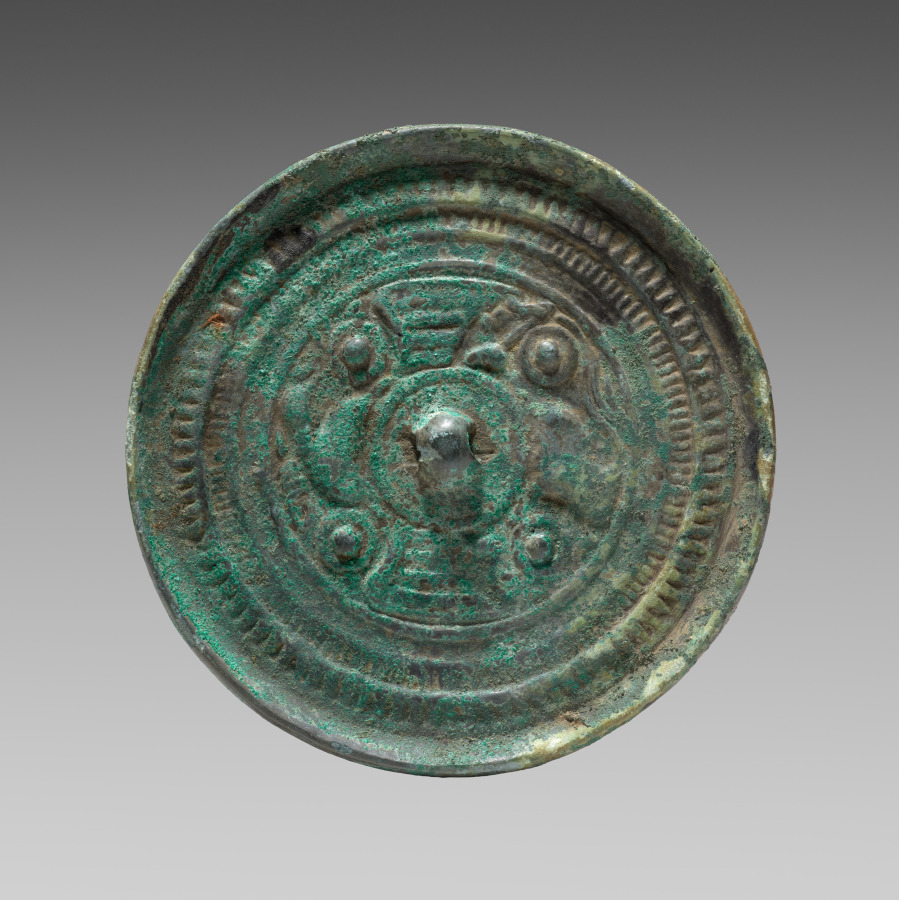
Mirror
Korea, Goryeo dynasty (918–1392) · 918–1392 · Cleveland Museum of Art
What did you think?
Guide
Adjust the guideNew to it · Medium
Nobody has listened to this guide yet. Making it takes about twenty seconds, and after that anyone can hear it straight away.
From the museum
From ancient times, a mirror assumed various roles; a ritualistic tool, a diplomatic gift, and a luxury commodity. During the Goryeo dynasty (918-1392), which saw the great advancement of metallurgy, the royal court was the center of distributing sophisticated bronze artifacts. According to historical records, on the 7th day of the Lunar New Year, the king bestowed a bronze mirror inscribed with auspicious symbols upon each court official as part of a ceremony to celebrate the Day of Humans. This explains why a large quantity of bronze mirrors were excavated from elite tombs. Due to its origin as an important tool in religion and politics, mirrors are often mentioned in many Korean proverbs that warn certain behaviors.
The museum’s own description, in English. Licence: CC0
Ask about this work
Ask in your own words. The answer comes from what the museum has written about the work, and says so when that does not hold it.
Details
- Maker
- Korea, Goryeo dynasty (918–1392)
- Date
- 918–1392
- Medium
- bronze
- Dimensions
- Diameter: 9.6 cm (3 3/4 in.)
- Place of origin
- Korea
- Held by
- Cleveland Museum of Art, Cleveland · On view · 003 Special Exhibition Hall
- Credit line
- Gift of John L. Severance
Image: Cleveland Museum of Art, CC0