Just a moment
Just a moment
A closer look, connecting key details with the work’s background.
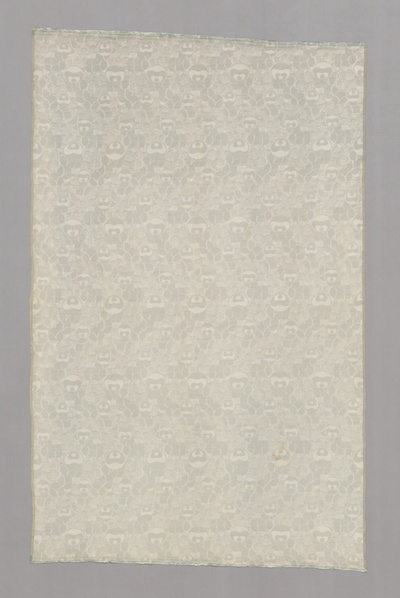
This is a length of woven fabric, about one hundred eighty-three centimeters tall and one hundred thirteen wide. That is roughly six feet by three and a half. It is made of silk, wild silk and cotton, and red is part of its color. Its subject is the poppy, shown in a flattened, simplified way. The pattern is not a single picture. It is a design that repeats, over and over, about forty-five centimeters in one direction and thirty in the other. So you are really looking at one idea, stitched together again and again across the cloth.
Start with the lines. Pick one poppy and follow its outline with your eyes. The lines are stretched long and thin, and the flower is reduced to a few simple shapes rather than every petal. Then notice the surface. The cloth is woven in a satin weave, which means long threads lie across the top and catch the light. That gives a soft sheen. Tilt your head or your phone and see how the pattern seems to shift between dull and glossy. Finally, find where the design begins to repeat, and see how smoothly one copy meets the next.
Koloman Moser, a prominent Viennese designer, created this design in 1900. It was woven by Johann Backhausen und Söhne, a Viennese firm founded in 1849 that is still in business today. The cloth was made on a loom with a Jacquard attachment, a device that controls the threads so that complicated patterns can be woven in. Backhausen produced the design in various colors. Moser was also a founder of the Vienna Secession, a group of young artists who broke away from the established Viennese art association. Three years after this textile, he cofounded the Wiener Werkstätte, a design workshop.
This textile points ahead. Made three years before the Wiener Werkstätte began, it foreshadows the elegant fabric designs Moser would later create there. Its thin, stretched lines and simplified natural forms show a new way of seeing that artists and designers in Vienna and Glasgow shared. The fabric was meant for upholstery or curtains, ideally in rooms where everything, from furniture to walls, was designed by Werkstätte artists as one total environment. Look once more at a single poppy and notice how little the designer needed to make it recognizable.
This guide was written by AI from material published by Art Institute of Chicago. Licence: CC BY 4.0
Save this version (English · New to it · Medium) with all its audio, guide text and work image. It replaces the saved guide for this work and language.
Audio storage: about 40 MB per guide and 150 MB on this device. Audio expires 7 days after it is downloaded.
Save this work’s image and museum information on this device to read without a connection.
Ask in your own words. The answer comes from what the museum has written about the work, and says so when that does not hold it.
Image: Art Institute of Chicago, CC0