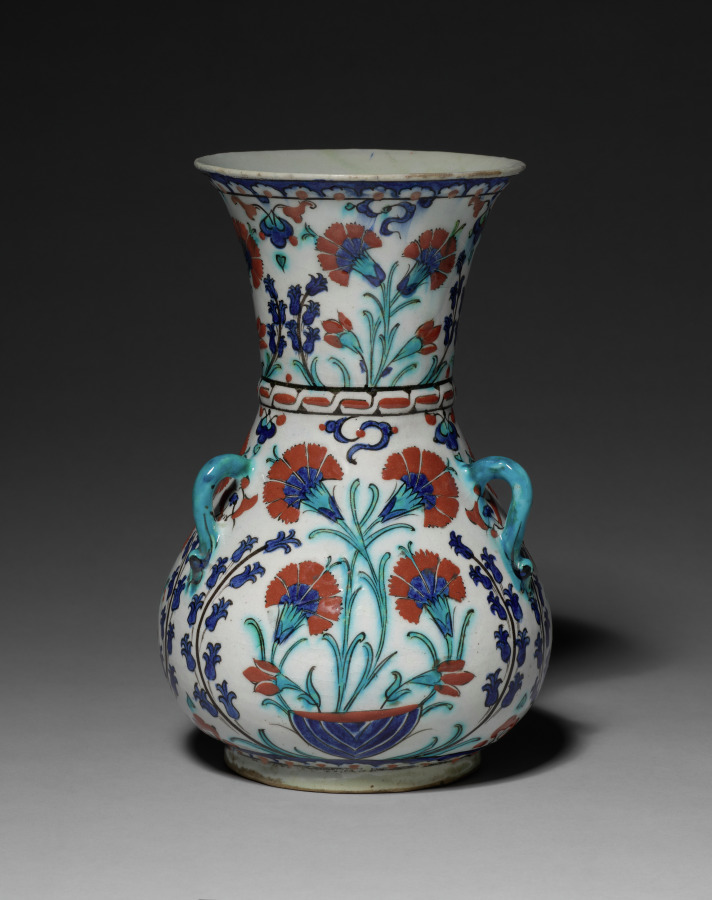
Mosque Lamp
Turkey, Iznik, Ottoman period (1299–1922) · 1585–95 · Cleveland Museum of Art
What did you think?
Save this work’s image and museum information on this device to read without a connection.
Guide
Adjust the guideNew to it · Medium
Nobody has listened to this guide yet. Making it takes about twenty seconds, and after that anyone can hear it straight away.
From the museum
Mosque lamps typically functioned as a lampshade, containing an oil lamp inside. Due to the opacity of this Ottoman lamp, it is likely that its primary function was not illumination. Instead, it would have been hung from chains in a mosque or mausoleum to add to the beauty of the space. This lamp is decorated with bright red carnations and blue hyacinths with additional floral and vegetal elements. The turquoise loops would have served for suspension from the ceiling. It is also possible that lamps like this were used as acoustic devices, softening the echo of prayer and discussion within the mosque’s halls. Fritware is made of ground quartz, glass frit (partially fused glass), and a small proportion of fine white clay to approximate the light color and weight of Chinese porcelain.
The museum’s own description, in English. Licence: CC0
Ask about this work
Ask in your own words. The answer comes from what the museum has written about the work, and says so when that does not hold it.
Details
- Maker
- Turkey, Iznik, Ottoman period (1299–1922)
- Date
- 1585–95
- Medium
- Fritware with underglaze design
- Dimensions
- Overall: 30.4 x 19.7 cm (11 15/16 x 7 3/4 in.); Diameter of rim: 19.7 cm (7 3/4 in.)
- Place of origin
- Turkey
- Held by
- Cleveland Museum of Art, Cleveland · On view · 116 Islamic
- Credit line
- Purchase from the J. H. Wade Fund
Image: Cleveland Museum of Art, CC0