Just a moment
Just a moment
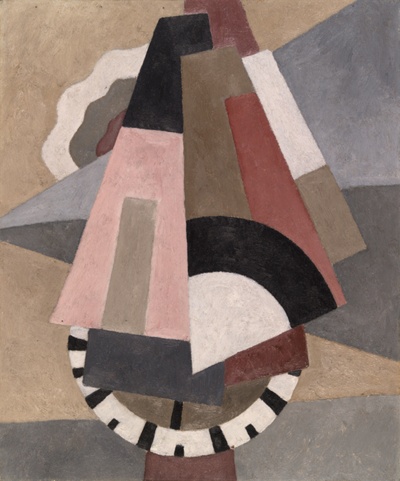
Marsden Hartley · 1913 · Art Institute of Chicago
This is a nearly square painting, about four feet on each side, made with oil paint on canvas. It does not show a person, a place, or an object you can name. Instead it is built from geometric shapes, and triangles are a main subject. The colors are bold and varied: pink, green, orange, yellow, blue, red, and black all appear. Stand back at first and let your eyes travel across the whole surface. The title, Movement, is a clue to what the painter wanted you to feel: a restless energy rather than a quiet scene.
Marsden Hartley was an American artist, born in 1877. Many American artists of his time looked to French modernism, meaning the new, experimental painting coming out of France. Hartley was drawn instead to German Expressionism, a style of painting from Germany. He made this work in Berlin in 1913, on the eve of World War I, so the war was close but had not yet begun. The painting's turbulent energy can recall the vibrancy of modern Berlin, the busy city where he was working.
Hartley wanted his painting to work more like music. He admired music because it does not tell a story, and because it can be purely spiritual, separate from the material world of everyday things. The Russian Expressionist painter Vasily Kandinsky shared this aim. So the painting does not ask you to find a scene. Its energy can suggest movements of music as well as the life of Berlin. Try looking at it the way you would listen to a piece of music: follow one color across the canvas, and notice how it meets the shapes around it.
This guide was written by AI from material published by Art Institute of Chicago. Licence: CC BY 4.0
Save this version (English · New to it · Medium) with all its audio, guide text and work image. It replaces the saved guide for this work and language.
Audio storage: about 40 MB per guide and 150 MB on this device. Audio expires 7 days after it is downloaded.
Save this work’s image and museum information on this device to read without a connection.
Ask in your own words. The answer comes from what the museum has written about the work, and says so when that does not hold it.
Image: Art Institute of Chicago, CC0