Just a moment
Just a moment
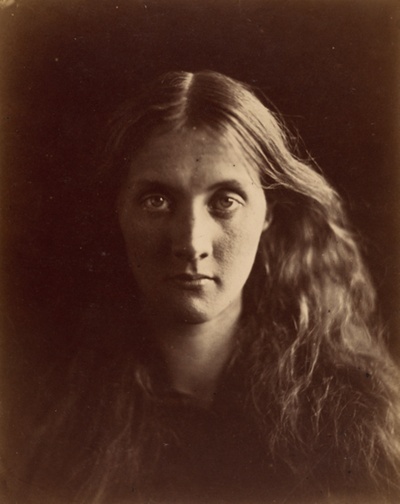
Julia Margaret Cameron · April 1867 · Art Institute of Chicago
This is a portrait photograph of a young woman named Julia Jackson, shown here under her married name, Mrs. Herbert Duckworth. It was made in April 1867 by Julia Margaret Cameron, who was her aunt. The print is about thirty-four centimeters tall and twenty-six wide, a little larger than a sheet of letter paper. It is an albumen print, which means the image sits in a thin coating of egg white on paper. Jackson was a favorite subject of Cameron's, who photographed her dozens of times over ten years.
Julia Margaret Cameron did not begin photographing until she was forty-eight, when her daughter and son-in-law gave her a camera as a gift. She quickly became obsessed. She loved the messy, almost magical side of the process, and she cared more about the overall effect of a picture than about getting every technical detail perfect. This portrait dates from April 1867. Earlier that spring, shortly before Jackson married her first husband, Herbert Duckworth, Cameron had made a series of portraits of the bride-to-be. This one was made after the wedding.
Cameron often dressed up friends, relatives, and servants to play the Virgin Mary, Queen Esther, or Shakespeare's loyal Cordelia. Julia Jackson was different. She was one of the few women who posed as herself. Known for her beauty all her life, she appears in Cameron's earlier portraits of her as noble, tender, and vulnerable. In this picture, made after her marriage, Cameron shows a more mature beauty and an extraordinary strength. Look at her face for a while, and see whether you can find both qualities there at once.
This guide was written by AI from material published by Art Institute of Chicago. Licence: CC BY 4.0
Save this version (English · New to it · Medium) with all its audio, guide text and work image. It replaces the saved guide for this work and language.
Audio storage: about 40 MB per guide and 150 MB on this device. Audio expires 7 days after it is downloaded.
Save this work’s image and museum information on this device to read without a connection.
Ask in your own words. The answer comes from what the museum has written about the work, and says so when that does not hold it.
Image: Art Institute of Chicago, CC0