Just a moment
Just a moment
Jean Baptiste Huet · c. 1786 · Art Institute of Chicago
A closer look, connecting key details with the work’s background.
This is a tall, narrow length of linen, about two and three quarter metres high and one metre wide. It is printed with a chinoiserie scene. That word means a European idea of Far Eastern design, imagined in a playful way rather than copied from real life. The subjects include women and men, umbrellas, boats, tents, birds, animals, flowers and trees. Look for a latticed teahouse or pagoda among them. A pagoda is a tiered tower with curving roofs. The linen is plain woven, and the design was printed from engraved copper plates.
The design is by Jean Baptiste Huet, after Jean Baptiste Pillement, and dates to about 1786. Huet trained as a painter and worked as chief designer at the Jouy-en-Josas Manufactory for twenty-eight years. Christopher-Philippe Oberkampf had founded the printing works there in 1760, and it became one of the most important in France. Copperplate printing means the pattern is engraved into a metal plate, inked, and pressed onto cloth. The method reached England by way of Ireland, and from there it found its way to France. The design repeats down the length of the fabric about every ninety-two centimetres.
Europeans in the eighteenth century were fascinated by the Far East. Entire rooms in palaces and hotels were decorated with furniture, porcelain, metalwork, lacquer and fabrics, all made as whimsical, westernized versions of Eastern forms and motifs. Many a European garden held a latticed teahouse or pagoda much like those pictured here. Panels like this one, with their large repeats, could cover chairs and sofas, or stretch across vast areas of wall. Look again at the teahouse or pagoda, and think of it standing in a real garden.
This guide was written by AI from material published by Art Institute of Chicago. Licence: CC BY 4.0
Save this version (English · New to it · Medium) with all its audio, guide text and work image. It replaces the saved guide for this work and language.
Audio storage: about 40 MB per guide and 150 MB on this device. Audio expires 7 days after it is downloaded.
Save this work’s image and museum information on this device to read without a connection.
Ask in your own words. The answer comes from what the museum has written about the work, and says so when that does not hold it.
Image: Art Institute of Chicago, CC0
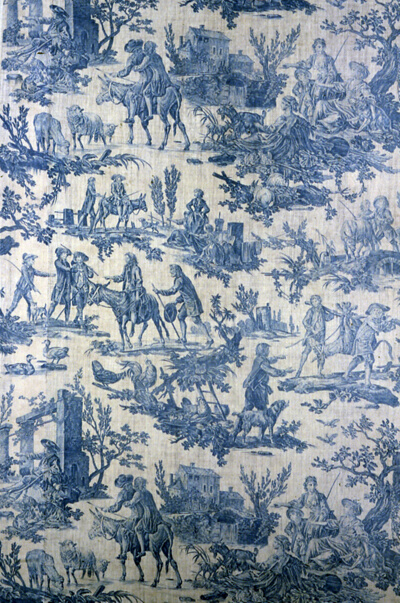 Le Meunier, Son Fils, et l'Ane (The Miller, His Son, and the Ass) (Furnishing Fabric)Jean Baptiste Huet · 1806
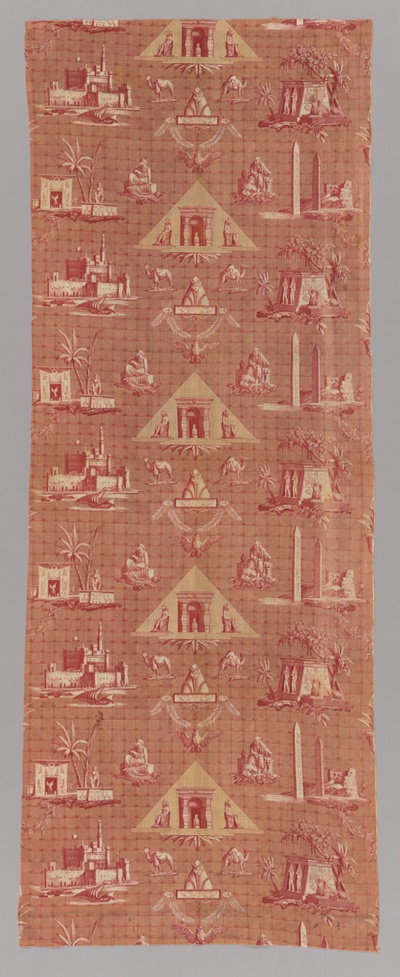 Les Monuments d'Egypte (The Monuments of Egypt) (Furnishing Fabric)Jean Baptiste Huet · c. 1800
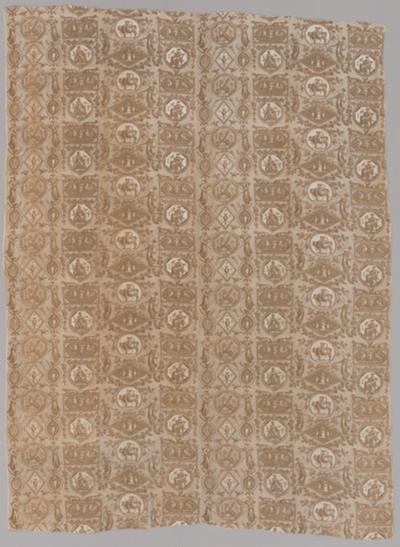 “Classical Medallions” Furnishing FabricJean Baptiste Huet · c. 1805/10
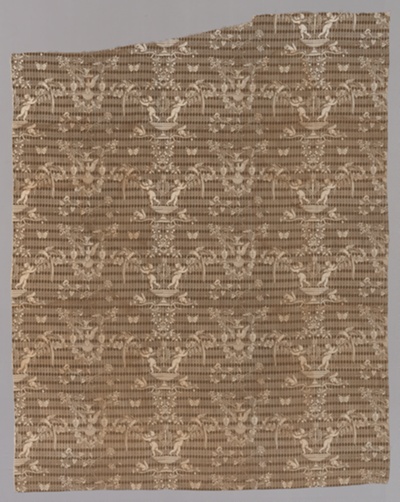 “Birds and Squirrels” Furnishing Fabric