Just a moment
Just a moment
Giovanni Battista Piazzetta · 1740 · Art Institute of Chicago
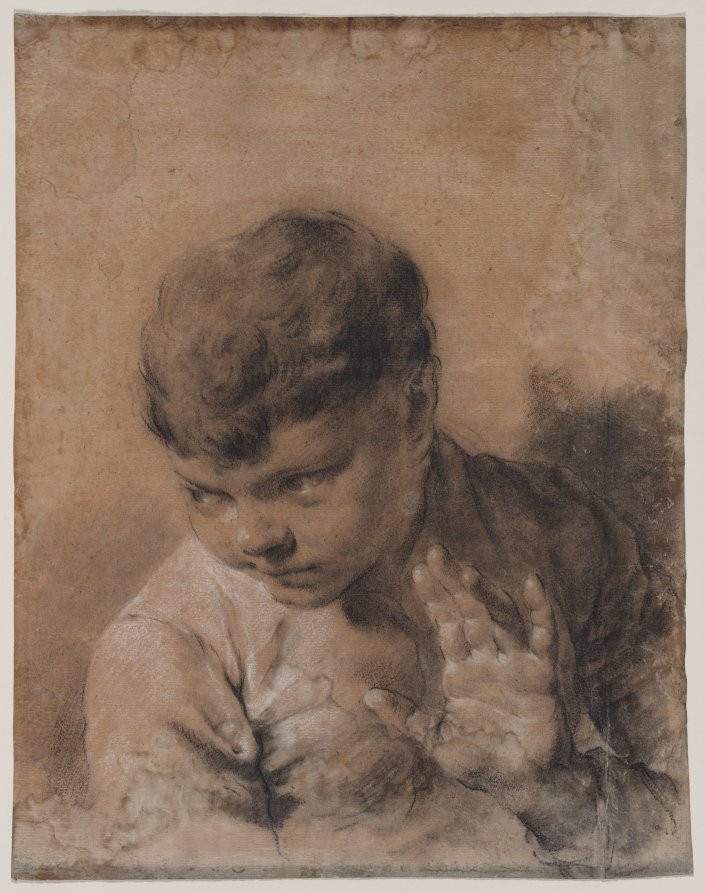
This is a large painting, about six feet tall and nearly five feet wide, made in oil paint on canvas. The figures are life-size country people, shown in a rustic scene. Among them are men, a woman with children, and a half-naked boy holding a basket of grapes. Animals share the scene too, including a dog and birds such as ducks. Because the figures are as big as real people, standing before the canvas can feel a little like stepping into their company. Begin with the boy and his grapes.
Giovanni Battista Piazzetta was one of the leading painters of Venice. He lived from 1682 to 1754 and painted this work in 1740. The earlier Baroque style, a style of the previous era, was known for gritty realism and dramatic light. Piazzetta turned those qualities into a more poetic style of his own. This is one of two paintings of life-size, rustic figures that he made for his patron, Field Marshall Johann Matthias von der Schulenberg. A patron is someone who pays an artist to create work.
What this painting means remains a mystery. The half-naked boy with the basket of grapes has been read as the infant Bacchus, the god of wine. Yet Piazzetta never mentioned any symbolic meaning when he described the work. More likely, he was answering his patron's taste for pastoral scenes. These were pictures of country life that appealed to middle- and upper-class city dwellers because they showed rural living in an idealized, gentler way. Look again at the boy and his grapes, and decide for yourself whether he is a god or simply a child.
This guide was written by AI from material published by Art Institute of Chicago. Licence: CC BY 4.0
Save this version (English · New to it · Medium) with all its audio, guide text and work image. It replaces the saved guide for this work and language.
Audio storage: about 40 MB per guide and 150 MB on this device. Audio expires 7 days after it is downloaded.
Save this work’s image and museum information on this device to read without a connection.
Ask in your own words. The answer comes from what the museum has written about the work, and says so when that does not hold it.
Image: Art Institute of Chicago, CC0