Peonies
Tatebayashi Kagei · mid 1700s · Cleveland Museum of Art
What did you think?
Save this work’s image and museum information on this device to read without a connection.
Guide
Adjust the guideNew to it · Medium
Nobody has listened to this guide yet. Making it takes about twenty seconds, and after that anyone can hear it straight away.
From the museum
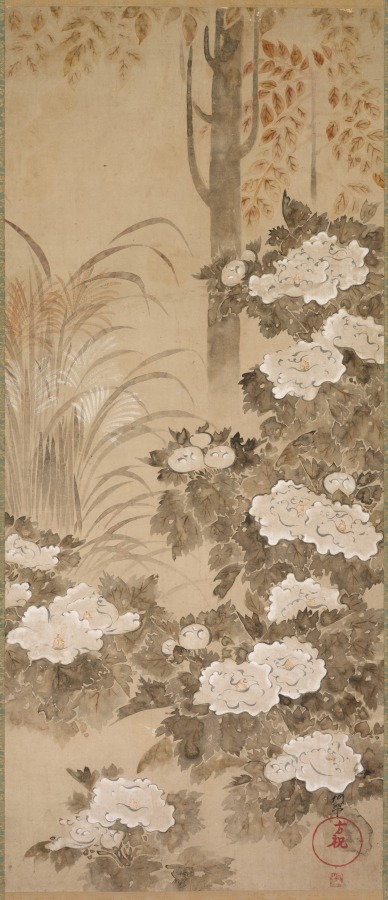
A proliferation of white tree peonies dominates this composition. Behind them are tall, feathery-topped susuki grasses and leafy deciduous trees. Tatebayashi Kagei restricted his palette to ink with red and white color, along with sparing use of green in the peony leaves and the blades of grass. He made generous use of the “dripping-in” (tarashikomi) technique, layering pooled ink and color, in the peony leaves. The areas left in reserve create the impression of insect-eaten or late season foliage. In 1738, Kagei received a copy made by Ogata Kōrin of a fan painting by Tawaraya Sōtatsu from Kōrin's brother Ogata Kenzan, so some think he trained with Kenzan in Edo (present-day Tokyo).
The museum’s own description, in English. Licence: CC0
Ask about this work
Ask in your own words. The answer comes from what the museum has written about the work, and says so when that does not hold it.
Details
- Maker
- Tatebayashi Kagei (Japanese, active mid-1700s)
- Date
- mid 1700s
- Medium
- hanging scroll; ink and color on paper
- Dimensions
- Painting only: 90.9 x 36.2 cm (35 13/16 x 14 1/4 in.)
- Place of origin
- Japan
- Held by
- Cleveland Museum of Art, Cleveland · Not on view
- Credit line
- Worcester R. Warner Collection
Image: Cleveland Museum of Art, CC0