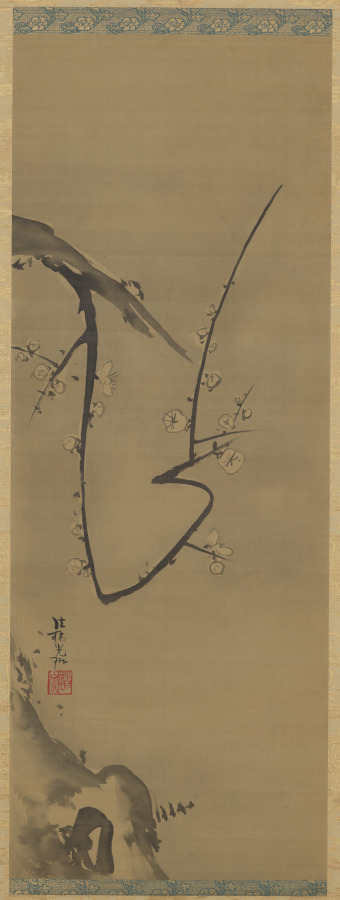
Plum Tree
Ogata Kōrin · c. 1700 · Cleveland Museum of Art
What did you think?
Save this work’s image and museum information on this device to read without a connection.
Guide
Adjust the guideNew to it · Medium
Nobody has listened to this guide yet. Making it takes about twenty seconds, and after that anyone can hear it straight away.
From the museum
Ogata Kōrin had to think through his design carefully to create these white plum blossoms and deliver their effect, as he used the reserve technique—where selected areas of the painting surface are left unpainted—to achieve it. He probably roughed in the tree before applying an ink wash to the entire silk surface, except where he intended to place the flowers. He likely then returned to articulate the petals and, in some cases, the pistils and stamens. The composition shows the tree twisting out of view, only to return with a branch of new growth jabbing forth from an old, broken limb, thereby heightening the visual impact of the blossoms. The Rinpa style of painting is named for Ogata Kōrin, even though he did not create it.
The museum’s own description, in English. Licence: CC0
Ask about this work
Ask in your own words. The answer comes from what the museum has written about the work, and says so when that does not hold it.
Details
- Maker
- Ogata Kōrin (Japanese, 1658–1716)
- Date
- c. 1700
- Medium
- hanging scroll; ink on silk
- Dimensions
- Image: 94 x 35.4 cm (37 x 13 15/16 in.); Including mounting: 177.2 x 51.8 cm (69 3/4 x 20 3/8 in.)
- Place of origin
- Japan
- Held by
- Cleveland Museum of Art, Cleveland · Not on view
- Credit line
- John L. Severance Fund
Image: Cleveland Museum of Art, CC0
More by Ogata Kōrin
Shown in
- Rinpa (琳派)Apr 23, 2021 – Oct 3, 2021
- Unfolding Beauty: Japanese Screens from the Cleveland Museum of ArtJul 15, 2001 – Sep 16, 2001
- Asian Autumn: Masterpieces from the CollectionSep 17, 1991 – Jan 5, 1992
- Rimpa PaintingSep 19, 1989 – Dec 17, 1989
- Suibokuga: Japanese Ink PaintingOct 1, 1985 – Feb 24, 1986