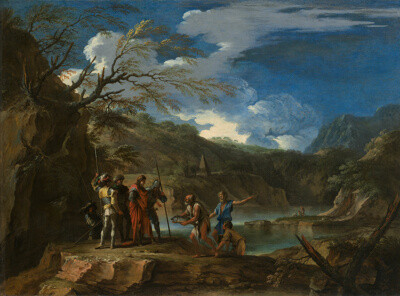
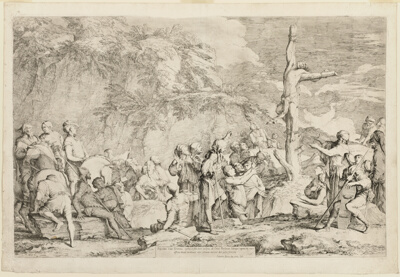
Polycrates' Crucifixion
Salvator Rosa · 1664 · Art Institute of Chicago
Guide
Adjust the guideNew to it · Medium
Nobody has listened to this guide yet. Making it takes about twenty seconds, and after that anyone can hear it straight away.
From the museum
A native of Naples, Salvator Rosa settled in Rome in 1649, producing dramatic works regarded as counterparts to the calm, classical landscapes of his contemporaries Claude Lorrain and Nicolas Poussin. Rosa’s landscapes present nature as wild, filled with striking effects of light, jagged cliffs, and dark grottoes. These qualities underline the eerie mood in his depiction of the death of Polycrates, ruler of the Greek island of Samos. Together with its companion piece Polycrates and the Fisherman, it illustrates the king’s inability to escape the ups and downs of fortune to which all humans are subject.
The museum’s own description, in English. Licence: CC BY 4.0
What did you think?
Save this work’s image and museum information on this device to read without a connection.
Ask about this work
Ask in your own words. The answer comes from what the museum has written about the work, and says so when that does not hold it.
Details
- Maker
- Salvator Rosa (Italian, 1615–1673)
- Date
- 1664
- Medium
- Oil on canvas
- Dimensions
- 73.4 × 98.9 cm (28 7/8 × 38 15/16 in.); Framed: 87 × 112.4 × 7 cm (34 1/4 × 44 1/4 × 2 3/4 in.)
- Place of origin
- Italy
- Held by
- Art Institute of Chicago, Chicago · On view · Gallery 209
- Credit line
- Wentworth Greene Field Memorial Fund
Image: Art Institute of Chicago, CC0