Pomona
Sir Edward Burne-Jones · Figure design 1882, background design 1898, made 1906 · Art Institute of Chicago
Guide
Adjust the guideNew to it · Medium
Looking for this guide.
From the museum
William Morris called tapestry weaving “the noblest of the weaving arts . . .in which nothing is mechanical.” The weaver’s skill in interpreting a complex and often delicate design was essential to creating a successful work. Tapestry weaving is slow and therefore expensive, which made such textiles inaccessible to most consumers. The hanging of Pomona, the goddess of orchards and gardens, was paired with another tapestry depicting Flora, the goddess of flowering plants. The first version of this pair was woven in the mid-1880s with a bold background of large leaves designed by William Morris. Smaller versions were later produced with the millefleurs design in the background by John Henry Dearle. The floral background resulted in a more harmonious composition, as Dearle’s smaller flowers were better suited to the delicate rendering of the goddesses.
The museum’s own description, in English. Licence: CC BY 4.0
What did you think?
Save this work’s image and museum information on this device to read without a connection.
Ask about this work
Ask in your own words. The answer comes from what the museum has written about the work, and says so when that does not hold it.
Details
- Maker
- After designs by Sir Edward Burne-Jones (English, 1833–1898) and John Henry Dearle (English, 1860–1932), Produced by Morris & Co., London (English, 1875-1940), Woven by Walter Taylor (English, 1875–1965) and John Keich (English, active 1890s–1910), Merton Abbey Tapestry Works, London (English, 1881–1940)
- Date
- Figure design 1882, background design 1898, made 1906
- Medium
- Cotton, wool, and silk, slit and double interlocking tapestry weave
- Dimensions
- 92.9 × 165.1 cm (36 1/2 × 65 in.)
- Place of origin
- England
- Held by
- Art Institute of Chicago, Chicago · Not on view
- Credit line
- Ida E. S. Noyes Fund
Image: Art Institute of Chicago, CC0
More by Sir Edward Burne-Jones
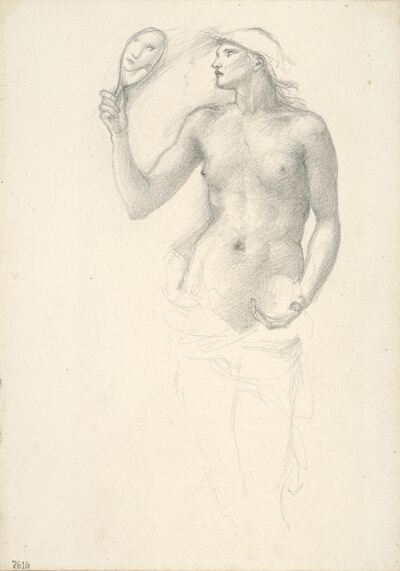
Venus with Golden Apple in Right Hand, for the Troy Triptych (sketchbook #2639)Sir Edward Burne-Jones · c. 1873–77
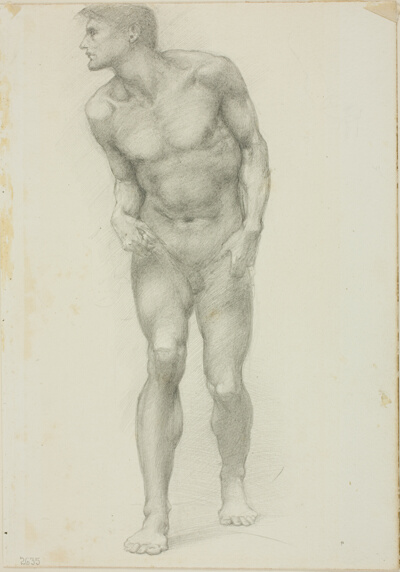
Male NudeSir Edward Burne-Jones · 1885
Paris with Golden Apple in Left Hand, for the Troy Triptych (sketchbook #2638)Sir Edward Burne-Jones · c. 1873–77
Cupid's Hunting FieldsSir Edward Burne-Jones · 1885
Shown in
- Morris and Company: The Business of BeautyDec 18, 2021 – Jun 13, 2022
- The Divine Art: Four Centuries of European TapestriesNov 1, 2008 – Jan 4, 2009
- European Textile Masterpieces from Coptic Times through the 19th CenturySep 27, 1989 – Jan 22, 1990
- Masterpieces of Western TextilesJan 25, 1969 – Mar 2, 1969