Just a moment
Just a moment
A closer look, connecting key details with the work’s background.
Looking for this guide.
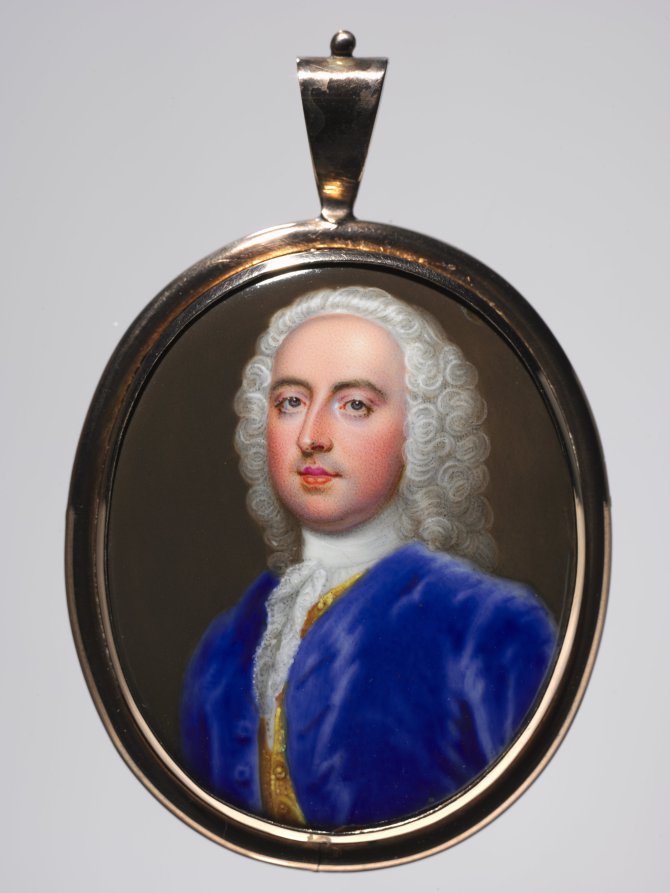
Unlike fragile portrait miniatures painted in watercolor on vellum or ivory, which are prone to cracking, fading, and flaking, enamels are resilient, impervious to the effects of light, and retain their striking original colors over time. Partly for this reason enamel was considered ideal for reproducing famous paintings and treasured portraits in a reduced and luminous form. The complicated and labor-intensive process of enameling required the artist to fire numerous layers of colored metal oxide at different temperatures, which made it difficult to produce a faithful portrait likeness, though masters of the medium were able create portraits of remarkable subtlety imbued with the sitter's personality. The heyday of enamel painting was the late 1600s and early 1700s. Among the enamel specialists was Zincke, who worked in England where he was patronized by Queen Anne, King George I, and King George II. Although miniatures are often regarded as a private art form exchanged between loved ones, the nature of this enamel was likely political.
The museum’s own description, in English. Licence: CC0
Save this work’s image and museum information on this device to read without a connection.
Ask in your own words. The answer comes from what the museum has written about the work, and says so when that does not hold it.
Image: Cleveland Museum of Art, CC0