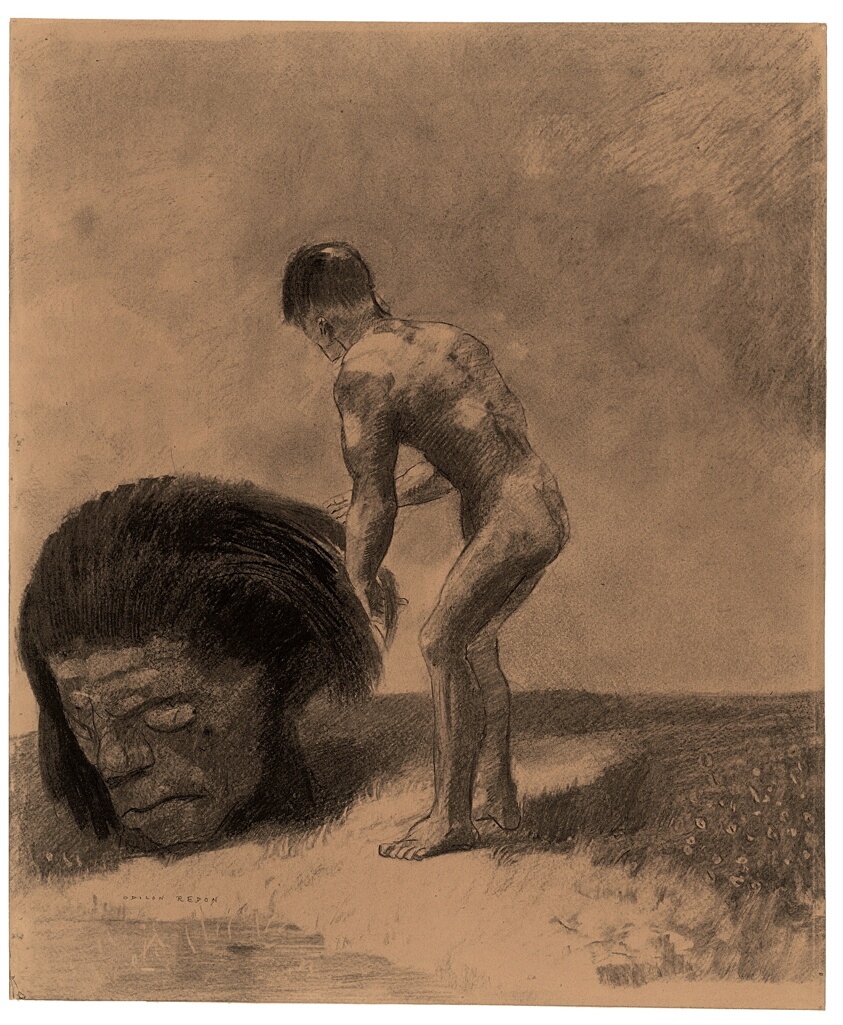
Primitive Being
Odilon Redon · c. 1876 · Art Institute of Chicago
What did you think?
Guide
Adjust the guideNew to it · Medium
Nobody has listened to this guide yet. Making it takes about twenty seconds, and after that anyone can hear it straight away.
From the museum
Odilon Redon himself described this drawing as representing “a primitive being contemplating the head of a giant.” During Redon’s life, new ideas of evolution provoked a fascination with other societies that were unmediated by industrialization and which Europeans viewed as “primitive” and closer to the natural world. Redon’s figures relate to these racially insensitive romanticized stereotypes, while also revealing other windows of creative thought. Although the work evokes the biblical story of David and Goliath, its mood is mysterious and reflective rather than triumphant. This is one of Redon’s celebrated black-and-white works he called “noirs” (blacks), which were strange, often disturbing images derived from the subconscious mind or dream world. In them, the artist deftly applied velvety charcoal and black chalk using a repertory of techniques—wiping, rubbing, erasing—to bring out a rich variety of tonal, chromatic, and textural effects.
The museum’s own description, in English. Licence: CC BY 4.0
Ask about this work
Ask in your own words. The answer comes from what the museum has written about the work, and says so when that does not hold it.
Details
- Maker
- Odilon Redon, French, 1840–1916
- Date
- c. 1876
- Medium
- Various charcoals and black chalk, with stumping, wiping, and erasing, fixed, on cream wove paper
- Dimensions
- 44.5 × 36.9 cm (17 9/16 × 14 9/16 in.)
- Place of origin
- France
- Held by
- Art Institute of Chicago, Chicago · Not on view
- Credit line
- Gift of Richard and Mary L. Gray
Image: Art Institute of Chicago, CC0