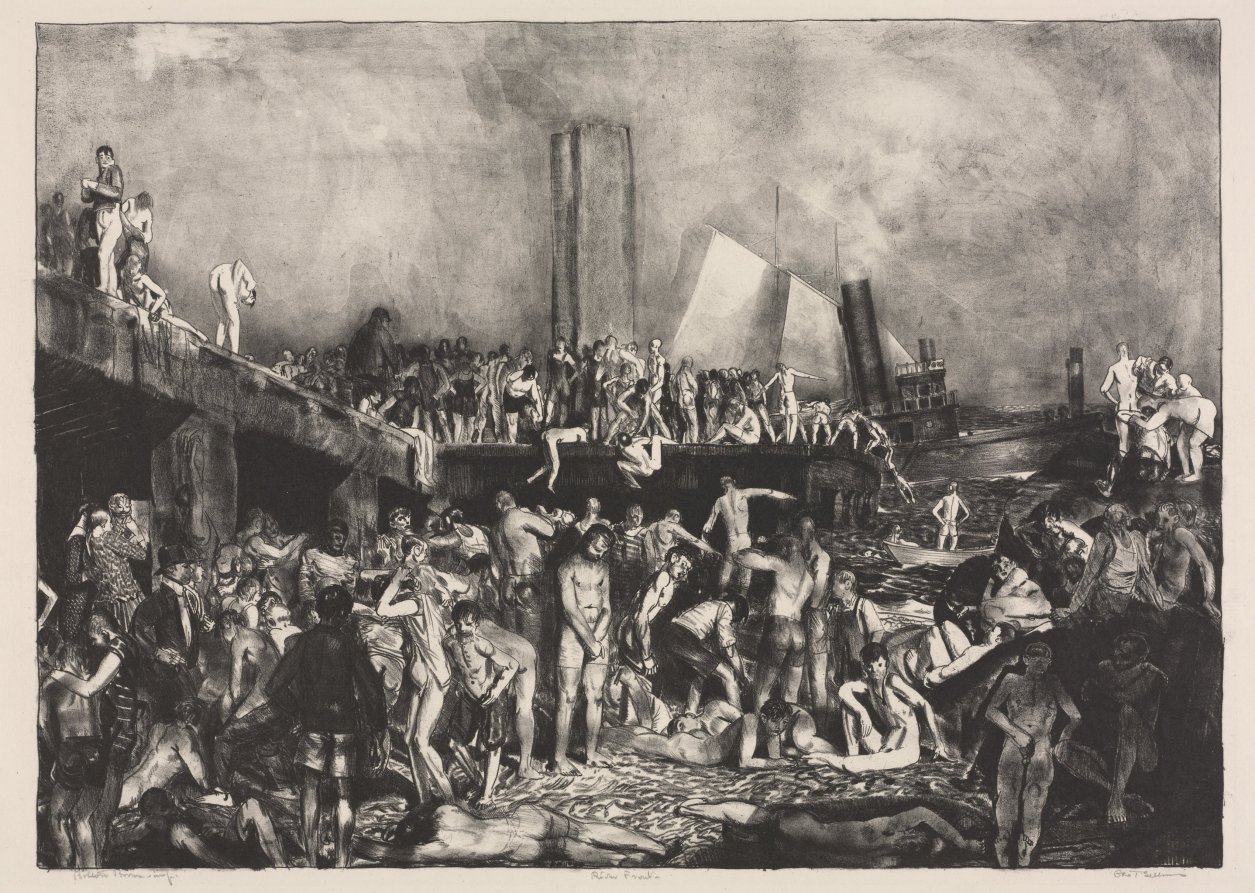
River-Front
George Bellows · 1924 · Cleveland Museum of Art
What did you think?
Save this work’s image and museum information on this device to read without a connection.
Guide
Adjust the guideNew to it · Medium
Nobody has listened to this guide yet. Making it takes about twenty seconds, and after that anyone can hear it straight away.
From the museum
During George Bellows’s first decade in New York City, starting in 1904, newspapers ran many stories about the “social problem” of the urban poor, reporting that the city’s tenement district lacked cleanliness and order. Drawn to this unvarnished side of city life, Bellows made several images of the public docks along the East River that were unofficial places of recreation for the city’s tenement children. Both Splinter Beach and River-Front feature, without sentimentality, children that display their nakedness unabashedly. Disturbingly, both images feature fully clothed adults observing or even touching children, as well as other sexual touching. Portrayals of sexual indecency in Bellows’s work aligned with the off-color humor often found in fictional representations of the urban poor of the time. Bellows created a dynamic triangle in this composition with the verticality of the central boy and lone building, the horizontal of the tugboat, and the two sails that complete the shape.
The museum’s own description, in English. Licence: CC0
Ask about this work
Ask in your own words. The answer comes from what the museum has written about the work, and says so when that does not hold it.
Details
- Maker
- George Bellows (American, 1882–1925)
- Date
- 1924
- Medium
- lithograph
- Dimensions
- Image: 38.1 x 53.2 cm (15 x 20 15/16 in.); Matted: 66 x 86.2 x 0.3 cm (26 x 33 15/16 x 1/8 in.); Platemark: 39.2 x 54.6 cm (15 7/16 x 21 1/2 in.); Sheet: 45.1 x 58.1 cm (17 3/4 x 22 7/8 in.)
- Place of origin
- America
- Held by
- Cleveland Museum of Art, Cleveland · Not on view
- Credit line
- Gift of Leonard C. Hanna Jr.
Image: Cleveland Museum of Art, CC0