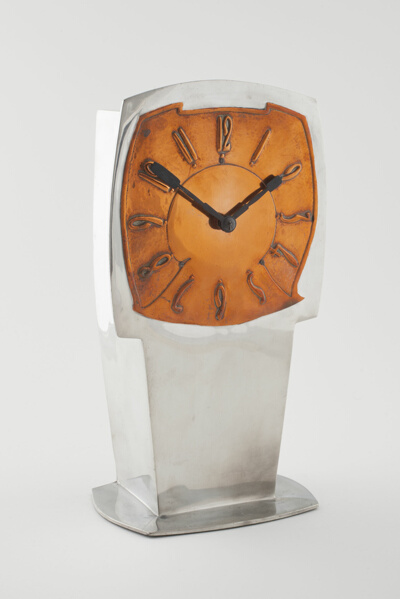
Rose Bowl
Archibald Knox · 1902 · Art Institute of Chicago
Guide
Adjust the guideNew to it · Medium
Looking for this guide.
From the museum
This bowl, which would have functioned as a centerpiece, is arguably the most important work designed by the Arts and Crafts artist Archibald Knox. Produced for the fashionable and innovative London department store Liberty and Company, the rose bowl incorporates Celtic motifs characteristic of Knox’s work and inspired by his childhood on the Isle of Man. Knox designed over 400 individual works—including clocks, biscuit tins, and tea sets—for Liberty’s Tudric (pewter) and Cymric (silver hollowware and jewelry) lines. The only example produced, this rose bowl, part of Knox’s Cymric line, represents the height of his achievement in silver. Early in his career, Knox trained under the designer Mackay Hugh Baillie Scott, at one time a fellow resident of the Isle of Man, and worked for Christopher Dresser.
The museum’s own description, in English. Licence: CC BY 4.0
What did you think?
Save this work’s image and museum information on this device to read without a connection.
Ask about this work
Ask in your own words. The answer comes from what the museum has written about the work, and says so when that does not hold it.
Details
- Maker
- Designed by Archibald Knox (English, 1864-1933), Made by Liberty & Co. (England, founded 1875)
- Date
- 1902
- Medium
- Silver, enamel, and turquoise
- Dimensions
- 19.1 × 35.3 cm (7 1/2 × 13 7/8 in.)
- Place of origin
- England
- Held by
- Art Institute of Chicago, Chicago · On view · Gallery 246
- Credit line
- Gift of Crab Tree Farm Foundation