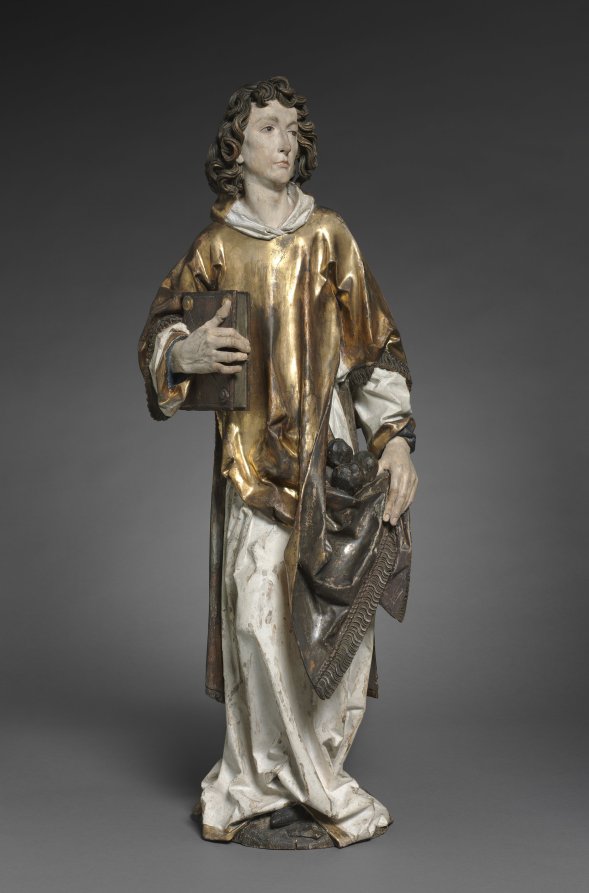
Saint Stephen
Tilman Riemenschneider · 1502–8 · Cleveland Museum of Art
What did you think?
Guide
Adjust the guideNew to it · Medium
Nobody has listened to this guide yet. Making it takes about twenty seconds, and after that anyone can hear it straight away.
From the museum
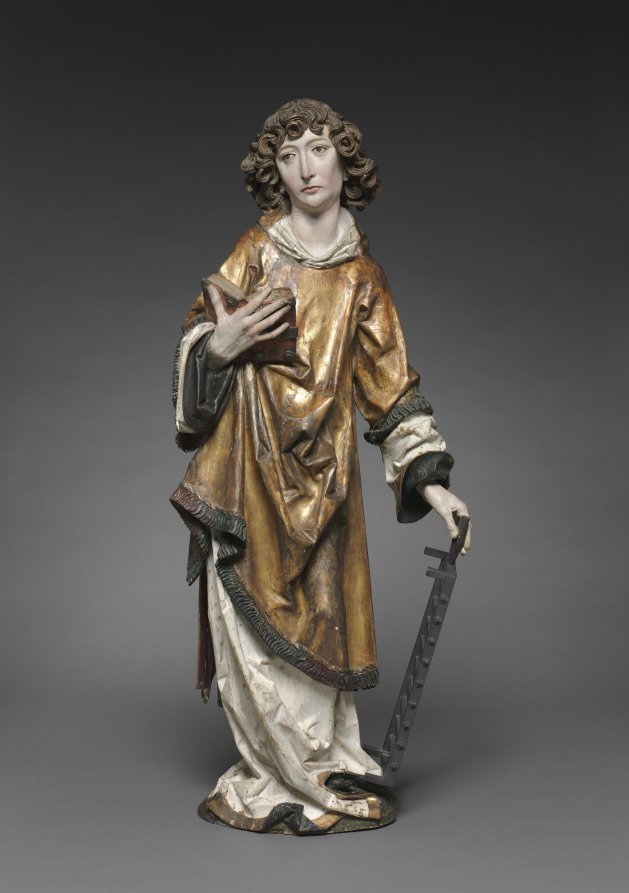
This sculpture, along with that of Saint Lawrence (1959.42) and two others in Germany, are believed to be the remaining fragments of a large altarpiece carved by Riemenschneider for the Dominican convent in Rothenburg in Franconia (demolished in 1813). Saints Stephen and Lawrence both wear the dalmatic to indicate their status as deacons in the early church. Each holds a symbol of his martyrdom; here, Saint Stephen cradles some stones to indicate his death by stoning. Art in Germany through the early 1500s remained firmly anchored in the late Gothic style with its associated interests in realism. Riemenschneider was one of the most prolific and versatile sculptors of this style, a recognized master in both stone and wood. His flourishing workshop employed as many as 40 apprentices in sculpting, woodcarving, and painting. His sculptures are noted for the dreamy, melancholy, and introspective quality in their expressions, as well as their remarkable attention to detail. Tilman Riemenschneider (c. 1460–1531) is probably the most famous German sculptor of the period around 1500.
The museum’s own description, in English. Licence: CC0
Ask about this work
Ask in your own words. The answer comes from what the museum has written about the work, and says so when that does not hold it.
Details
- Maker
- Tilman Riemenschneider (German, active Würzburg, c. 1460–1531)
- Date
- 1502–8
- Medium
- lindenwood with polychromy and gilding
- Dimensions
- Overall: 93.5 x 35 x 23.5 cm (36 13/16 x 13 3/4 x 9 1/4 in.)
- Place of origin
- Germany
- Held by
- Cleveland Museum of Art, Cleveland · On view · 111 German and Austrian Gothic
- Credit line
- Leonard C. Hanna Jr. Fund
Image: Cleveland Museum of Art, CC0