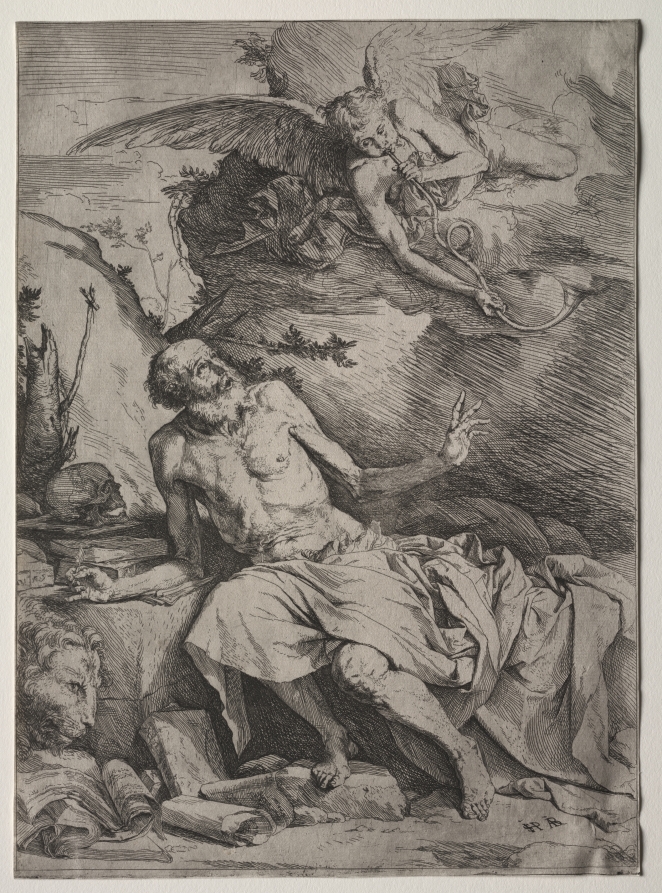
Silenus
Jusepe de Ribera · 1628 · Cleveland Museum of Art
Guide
Adjust the guideNew to it · Medium
Nobody has listened to this guide yet. Making it takes about twenty seconds, and after that anyone can hear it straight away.
From the museum
Before a large wine barrel, Silenus (Bacchus’s teacher) lies inebriated on the ground as he raises his cup to receive wine from a satyr in this print. Jusepe de Ribera included these and other details indicating that the scene was intended to be humorous. Two infants mimic Silenus, and a braying donkey adds to the chaotic setting. Pan, patron of shepherds, with his pipe and staff at his feet, crowns Silenus with grapevines. A satyr and a maenad, at upper left, contribute music as well as sexual innuendo (implied by the placement of the satyr’s flute). Ribera drew inspiration from Andrea Mantegna’s bacchanalia image but he introduced more texture and sensuality to the subject matter through his rich etching technique. Corpulent bodies were often used in early modern art to symbolize laziness, overindulgence, and moral corruption.
The museum’s own description, in English. Licence: CC0
What did you think?
Save this work’s image and museum information on this device to read without a connection.
Ask about this work
Ask in your own words. The answer comes from what the museum has written about the work, and says so when that does not hold it.
Details
- Maker
- Jusepe de Ribera (Spanish, 1591–1652)
- Date
- 1628
- Medium
- etching
- Dimensions
- Sheet: 27 x 35 cm (10 5/8 x 13 3/4 in.)
- Place of origin
- Spain
- Held by
- Cleveland Museum of Art, Cleveland · Not on view
- Credit line
- Andrew R. and Martha Holden Jennings Fund
Image: Cleveland Museum of Art, CC0