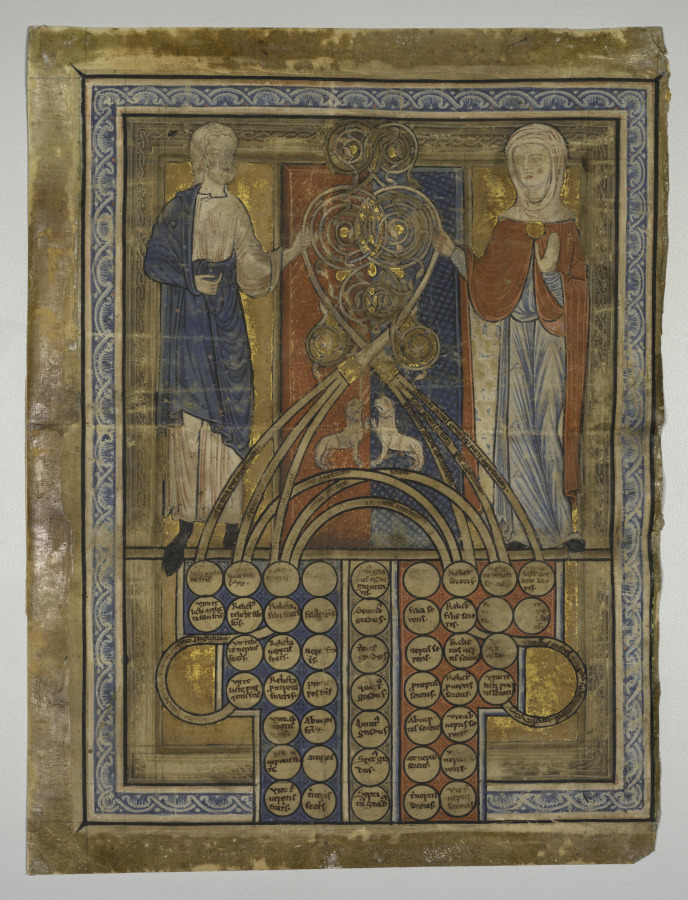
Single Leaf: Table of Consanguinity
England · c. 1200 · Cleveland Museum of Art
What did you think?
Guide
Adjust the guideNew to it · Medium
Nobody has listened to this guide yet. Making it takes about twenty seconds, and after that anyone can hear it straight away.
From the museum
Consanguinity diagrams were used to show the degree of kinship between an individual and his or her "blood" relations. These tables followed an established tradition dating back to around AD 600. Until church law was relaxed in 1215, a marriage could only be contracted by persons separated by seven degrees of relationship. After 1215 the degree of separation was reduced to four. Tables of Consanguinity were therefore used by church officials to prove or disprove bars to marriage.
The museum’s own description, in English. Licence: CC0
Ask about this work
Ask in your own words. The answer comes from what the museum has written about the work, and says so when that does not hold it.
Details
- Maker
- England
- Date
- c. 1200
- Medium
- ink, tempera, and gold on vellum
- Dimensions
- Sheet: 28.9 x 21.8 cm (11 3/8 x 8 9/16 in.)
- Place of origin
- England
- Held by
- Cleveland Museum of Art, Cleveland · On view · 115 Manuscripts & Textiles
- Credit line
- Gift from J. H. Wade
Image: Cleveland Museum of Art, CC0