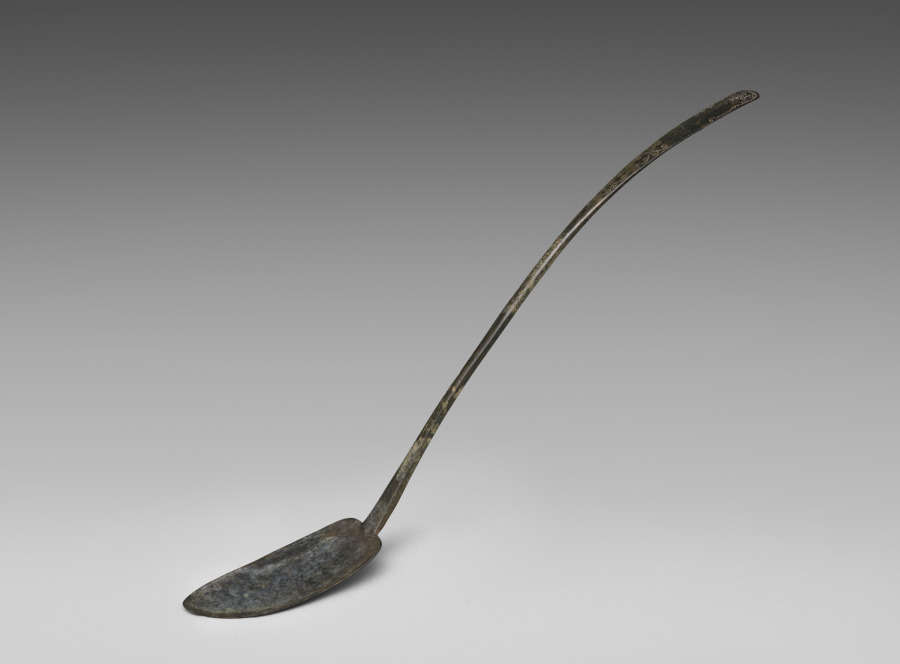
Spoon
Korea, Goryeo dynasty (918–1392) · 918–1392 · Cleveland Museum of Art
What did you think?
Guide
Adjust the guideNew to it · Medium
Nobody has listened to this guide yet. Making it takes about twenty seconds, and after that anyone can hear it straight away.
From the museum
Celadons, spoons, seals, and bronze mirrors were the most common burial objects in tombs during the Goryeo period (918–1392). Furnishing tombs with an elaborate assemblage of objects was believed to honor and comfort the newly dead. Generally, Goryeo tombs were left untouched until the late 19th century. During the colonial period (1910–45), however, Japanese archaeologists hastily excavated the tombs located in Kaeseong, the former capital of the Goryeo period. Scholars recently have proposed that toward the end of the 14th century, Koreans enjoyed meat-based soups more than any other dishes, explaining why many more spoons than chopsticks were buried in tombs. Bronze spoons are the most common burial item. Scholars have proposed that toward the end of the 14th century, Koreans enjoyed meat-based soups more than any other dishes, explaining why spoons became common household items as well as burial goods.
The museum’s own description, in English. Licence: CC0
Ask about this work
Ask in your own words. The answer comes from what the museum has written about the work, and says so when that does not hold it.
Details
- Maker
- Korea, Goryeo dynasty (918–1392)
- Date
- 918–1392
- Medium
- silver bronze
- Dimensions
- Overall: 31.8 cm (12 1/2 in.)
- Place of origin
- Korea
- Held by
- Cleveland Museum of Art, Cleveland · On view · 003 Special Exhibition Hall
- Credit line
- General Income Fund
Image: Cleveland Museum of Art, CC0