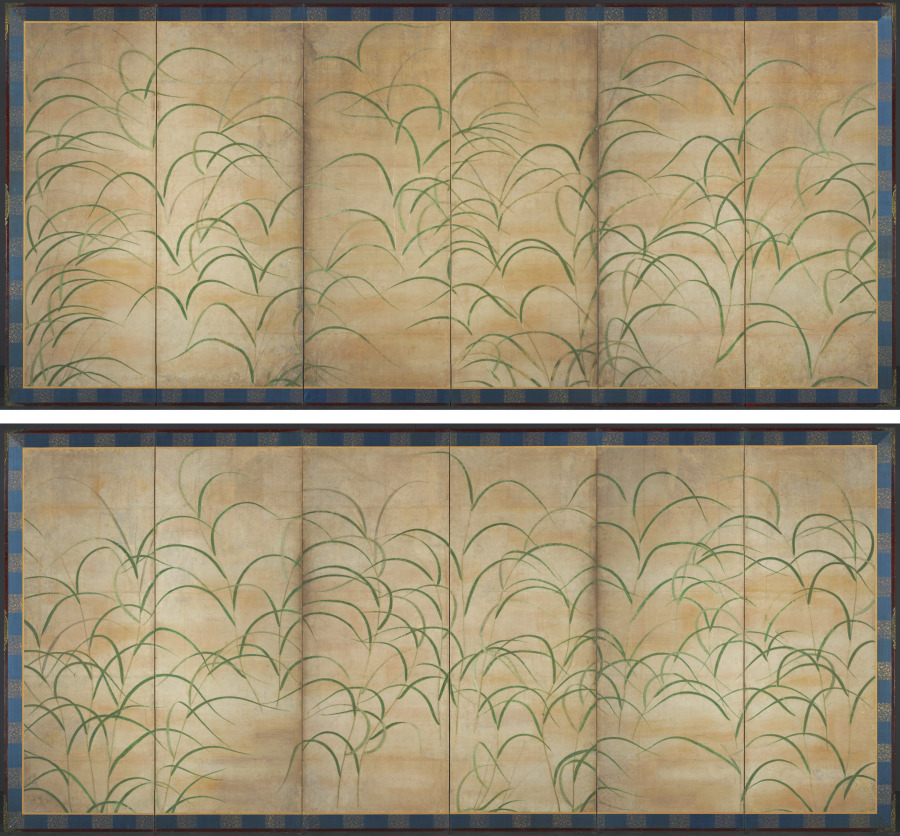
Susuki Grass
Japan, Muromachi period (1392–1573) · c. 1525 · Cleveland Museum of Art
What did you think?
Guide
Adjust the guideNew to it · Medium
Nobody has listened to this guide yet. Making it takes about twenty seconds, and after that anyone can hear it straight away.
From the museum
Susuki grass has a seasonal association with autumn in the Japanese visual and literary tradition. It is one of the “Seven Flowers of Autumn,” along with bush clover, arrowroot, pink, patrinia, mistflower, and bellflower. This composition immerses the beholder in a field of grasses and golden bands of mist. The design may have served as a backdrop for poems brushed in ink on decorated papers and attached to the surface of the screens, a practice with a long tradition in Japan. The botanical name for susuki grass is miscanthus.
The museum’s own description, in English. Licence: CC0
Ask about this work
Ask in your own words. The answer comes from what the museum has written about the work, and says so when that does not hold it.
Details
- Maker
- Japan, Muromachi period (1392–1573)
- Date
- c. 1525
- Medium
- Pair of six-panel folding screens; ink, color, and gold on paper
- Dimensions
- Overall: 150.3 x 348.8 cm (59 3/16 x 137 5/16 in.)
- Place of origin
- Japan
- Held by
- Cleveland Museum of Art, Cleveland · Not on view
- Credit line
- John L. Severance Fund
Image: Cleveland Museum of Art, CC0
Shown in
- Highlights of Japanese ArtDec 7, 2025 – Jun 14, 2026
- Japanese Gallery 235 RotationJan 7, 2019 – Jul 8, 2019
- Unfolding Beauty: Japanese Screens from the Cleveland Museum of ArtJul 15, 2001 – Sep 16, 2001
- The Triumph of Japanese Style: 16th Century Art in JapanOct 19, 1991 – Dec 1, 1991
- Rimpa PaintingSep 19, 1989 – Dec 17, 1989