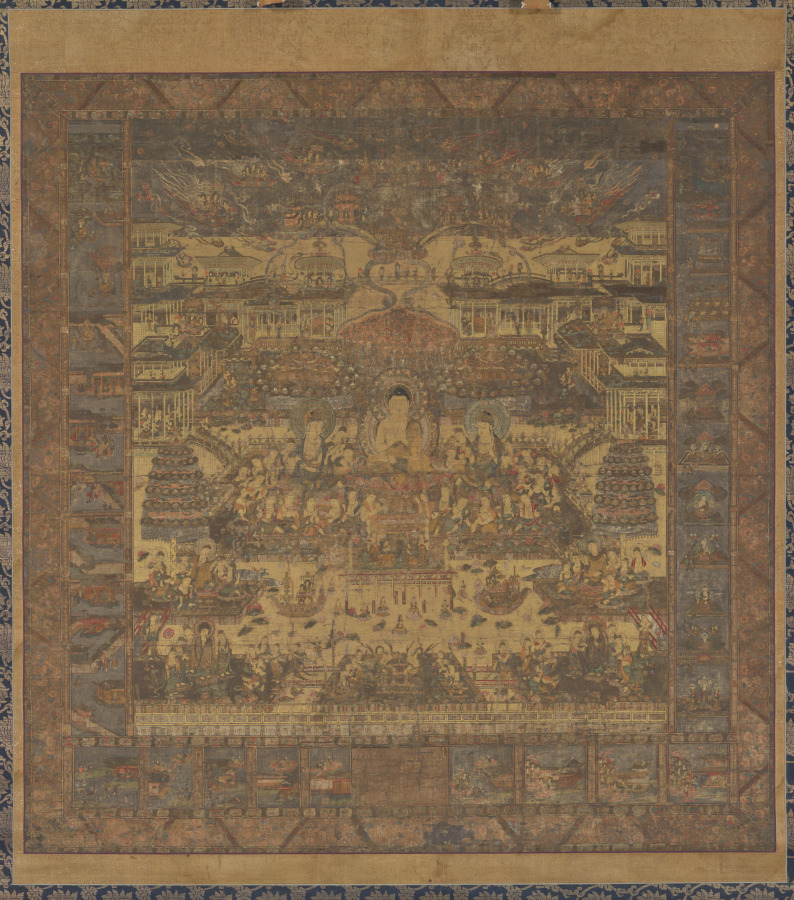
Taima Mandala
Japan, Kamakura period (1185–1333) · early 1300s · Cleveland Museum of Art
What did you think?
Save this work’s image and museum information on this device to read without a connection.
Guide
Adjust the guideNew to it · Medium
Nobody has listened to this guide yet. Making it takes about twenty seconds, and after that anyone can hear it straight away.
From the museum
This painting is a copy after an 8th-century woven mandala belonging to the temple Taimadera. The composition is based on a sacred text that describes the Buddha Shakyamuni’s explanation of Amida’s Pure Land to Queen Vaidehi, as well as his instructions to her on visual meditation upon the Pure Land. The Pure Land appears at the center of the painting. To the left is the story of Queen Vaidehi’s encounter with Shakyamuni, and to the right are the scenes she is given to visualize. The bottom illustrates the nine levels of birth that can be attained in the Pure Land.
The museum’s own description, in English. Licence: CC0
Ask about this work
Ask in your own words. The answer comes from what the museum has written about the work, and says so when that does not hold it.
Details
- Maker
- Japan, Kamakura period (1185–1333)
- Date
- early 1300s
- Medium
- hanging scroll; ink, color, and gold on silk
- Dimensions
- Painting: 135.6 x 140.3 cm (53 3/8 x 55 1/4 in.); Mounted: 170.5 x 203.2 cm (67 1/8 x 80 in.)
- Place of origin
- Japan
- Held by
- Cleveland Museum of Art, Cleveland · Not on view
- Credit line
- Severance and Greta Millikin Purchase Fund
Image: Cleveland Museum of Art, CC0