Just a moment
Just a moment
Ancient Greek · 336-323 BCE · Art Institute of Chicago
A closer look, connecting key details with the work’s background.
Looking for this guide.
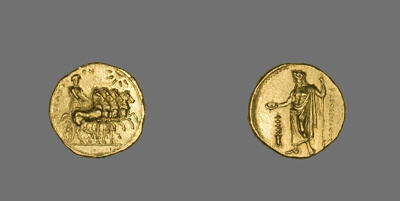
The purpose of the first portrait coins was to identify the ruler. The front side became a mirror of the sovereign’s self-image. The back was often used to communicate the ruler’s accomplishments or intentions. The profile portrait was used because it suited the very shallow depth and limited surface of the coin. The tiny images were carved by engravers into bronze dies, one for the front and another for the back. The coins were then struck, one by one, in a process similar to how modern coins are created today. Certainly the best-known face in antiquity was that of Alexander the Great (reigned 336–323 BCE), whose profile, seen in this coin here, graced coins for two hundred years. He collected the treasure of conquered kingdoms as he swept across the Near East, and with this rich booty he set up mints that produced coins bearing his portrait. The back (reverse) of this coin depicts the god Zeus draped and seated on a backless throne; in his extended right hand he holds an eagle, wings folded.
The museum’s own description, in English. Licence: CC BY 4.0
Save this work’s image and museum information on this device to read without a connection.
Ask in your own words. The answer comes from what the museum has written about the work, and says so when that does not hold it.
Image: Art Institute of Chicago, CC0