Just a moment
Just a moment
Paul Cezanne · c. 1885 · Art Institute of Chicago
A closer look, connecting key details with the work’s background.
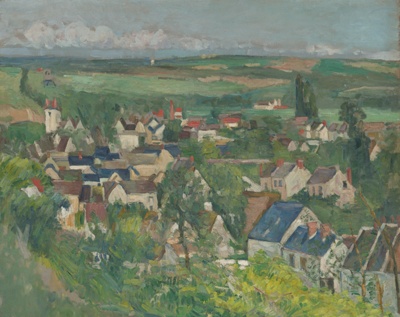
This is an oil painting on canvas, about a metre wide and a little less tall. It shows a view across water from L'Estaque, looking toward the bay of Marseille. The picture is packed with color and feels very full. Cézanne split the scene into four zones: buildings, water, mountain, and sky. Start at the bottom, where village forms sit in the foreground. Above them the blue water stretches across the middle. A mountain rises beyond the water, and the sky fills the top of the canvas.
Look first at the brushstrokes. Cézanne used small blocky marks, almost like tiles, to build up the water, hills and buildings. Next, trace the lines. Follow the horizontal line of the water, the upright edges of the buildings, and the slanting lines of the mountain. Together they make a kind of grid across the canvas. Finally, notice how the shapes sit against each other. Strong, contrasting colors define each one, yet the edges seem to touch and shift rather than lock firmly in place.
Cézanne painted this around 1885. It is one of more than a dozen views of this landscape that he made during the 1880s. He wrote about it in a letter to his friend and teacher, the painter Camille Pissarro. In that letter, he compared the view of the sea from L'Estaque to a playing card, with its simple shapes and colors. The configuration and color of the place clearly fascinated him, and he came back to it again and again.
Impressionists, the painters around Cézanne, often painted water, sky, mountains and buildings too. But their main aim was to record the passing effects of light. Cézanne cared more about the underlying structure of what he saw. His picture looks back to traditional landscape painting, yet it also points ahead to Cubism, a later style built from broken-up shapes. Look a little longer at the blocky strokes. They make the scene seem both flat, like a pattern, and deep, like real space, and that tension is what brings it to life.
This guide was written by AI from material published by Art Institute of Chicago. Licence: CC BY 4.0
Save this version (English · New to it · Medium) with all its audio, guide text and work image. It replaces the saved guide for this work and language.
Audio storage: about 40 MB per guide and 150 MB on this device. Audio expires 7 days after it is downloaded.
Save this work’s image and museum information on this device to read without a connection.
Ask in your own words. The answer comes from what the museum has written about the work, and says so when that does not hold it.
Image: Art Institute of Chicago, CC0