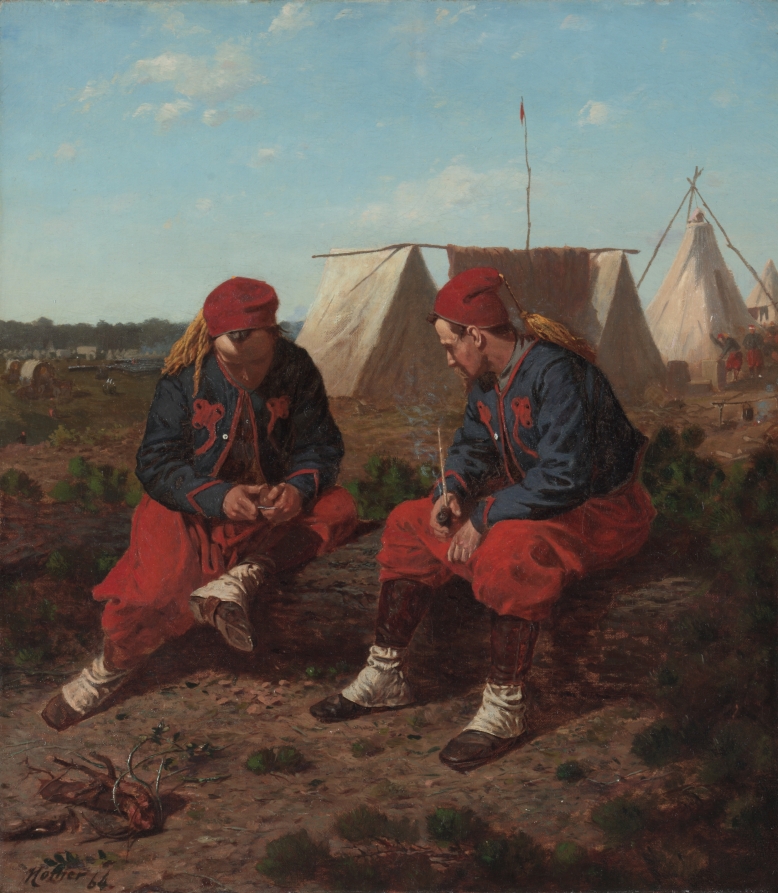
The Brierwood Pipe
Winslow Homer · 1864 · Cleveland Museum of Art
What did you think?
Guide
Adjust the guideNew to it · Medium
Nobody has listened to this guide yet. Making it takes about twenty seconds, and after that anyone can hear it straight away.
From the museum
Created during the United States Civil War, Winslow Homer’s painting depicts two volunteers for the Union Army who sport their regiment’s highly colorful uniforms, a design discovered to be impractical due to its ability to be spotted by sharpshooters. Passing idle time in their encampment, one soldier holds a lit pipe and watches his companion whittle a block of wood. The painting shares its title with a contemporary poem, in which a soldier smokes a brierwood pipe and daydreams of the time when the conflict will end so he can return home. The museum acquired this painting during World War II, and it seems likely that the painting’s subject was viewed as especially significant for its wartime audience. During the Civil War, Homer worked as an artist-reporter for the New York newspaper Harper's Weekly.
The museum’s own description, in English. Licence: CC0
Ask about this work
Ask in your own words. The answer comes from what the museum has written about the work, and says so when that does not hold it.
Details
- Maker
- Winslow Homer (American, 1836–1910)
- Date
- 1864
- Medium
- oil on canvas
- Dimensions
- Framed: 68.9 x 64.1 x 9.2 cm (27 1/8 x 25 1/4 x 3 5/8 in.); Unframed: 42.8 x 37.5 cm (16 7/8 x 14 3/4 in.); Former: 69 x 64 x 8 cm (27 3/16 x 25 3/16 x 3 1/8 in.)
- Place of origin
- United States
- Held by
- Cleveland Museum of Art, Cleveland · On view · 001A ArtLens Exhibition
- Credit line
- Mr. and Mrs. William H. Marlatt Fund
Image: Cleveland Museum of Art, CC0