Just a moment
Just a moment
Frederic Remington · Modeled 1895, cast 1899 · Art Institute of Chicago
A closer look, connecting key details with the work’s background.
This bronze sculpture shows a cowboy on a horse that is trying to throw him. A bronco is a wild or untrained horse, and a buster is someone who tames it. The work stands about sixty centimeters tall, a little under two feet, so it is small enough to sit on a table. Look at the whole shape first. The horse is caught in mid-motion, and the rider is locked on top of it. The metal has a brown surface finish, called a patina, which gives the figures a warm, earthy color.
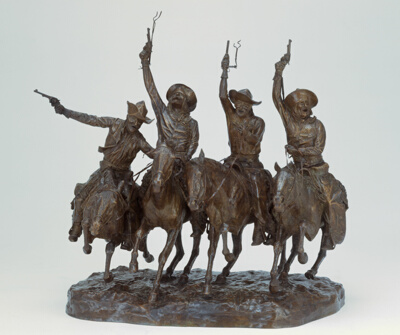
Frederic Remington was an American artist from the 1800s. He first found success as a painter and illustrator, making pictures of frontier life. The Bronco Buster was his first attempt at sculpture. He modeled it in 1895 in New York City. It was cast in 1899 by the Henry-Bonnard Bronze Company. Casting means pouring melted metal into a mold to make the final object. The museum describes the piece as a technical achievement in bronze, meaning it was difficult to make well in this medium.
This sculpture presents the American West as dramatic and violent. It shows a white cowboy, part of a wave of settlers, forcing a wild animal into submission. Remington was known for romanticized, mythic views of frontier life. For white audiences living east of the Mississippi River around 1900, figures like this one came to stand for the West. But it was a distorted picture of a place they did not know. Look at the rider's grip and the horse's twisting body, and ask what story the sculpture is telling you.
This guide was written by AI from material published by Art Institute of Chicago. Licence: CC BY 4.0
Save this version (English · New to it · Medium) with all its audio, guide text and work image. It replaces the saved guide for this work and language.
Audio storage: about 40 MB per guide and 150 MB on this device. Audio expires 7 days after it is downloaded.
Save this work’s image and museum information on this device to read without a connection.
Ask in your own words. The answer comes from what the museum has written about the work, and says so when that does not hold it.
Image: Art Institute of Chicago, CC0