Just a moment
Just a moment
Hubert Robert · 1787–88 · Art Institute of Chicago
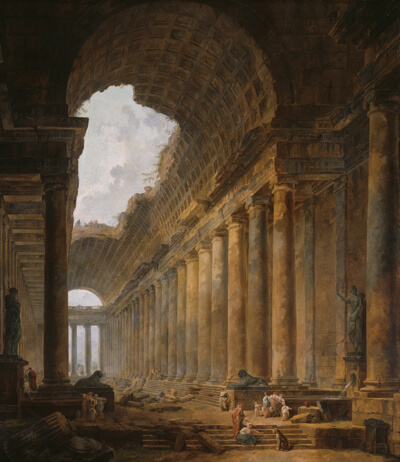
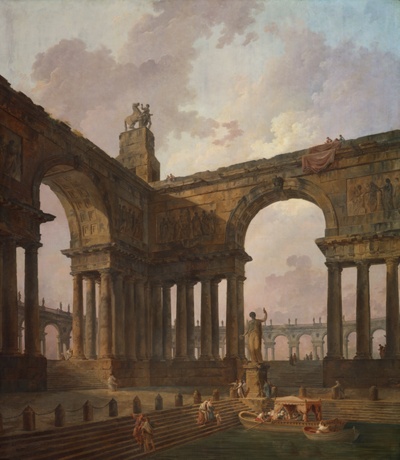
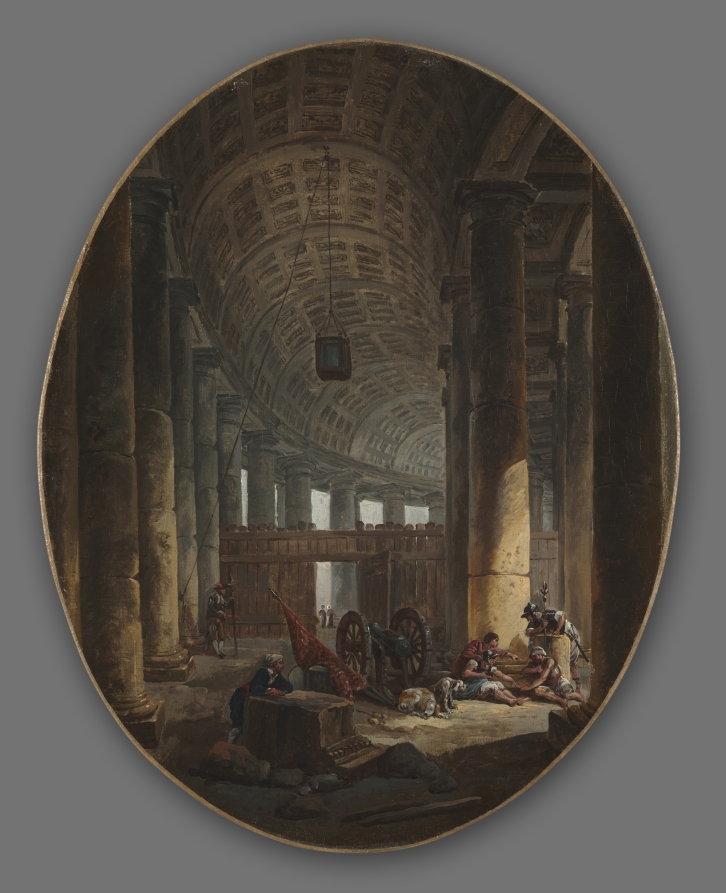
This is a very large painting, taller than most doors, at about two and a half metres high. It is oil paint on canvas, made by Hubert Robert in 1787 and 1788. It shows an imagined scene of Classical ruins, the broken remains of buildings in the style of ancient Rome. Fountains belong to the scene, and there are arches, columns and statues of Roman type. The space seems to stretch far back, grand and open. Tiny people stand in the foreground, and they look very small beside the architecture around them.
Start with the tiny figures in the foreground, near the bottom of the picture. They are very small, and they are there to show you how big everything else is. Then let your eye travel upward and inward. Look for arches, rows of columns called colonnades, and ceilings made of sunken square panels, known as coffered vaults. Look also for niches, which are hollow spaces in a wall, often holding statues. Many of these are invented by the painter. Together they build a deep, echoing space.
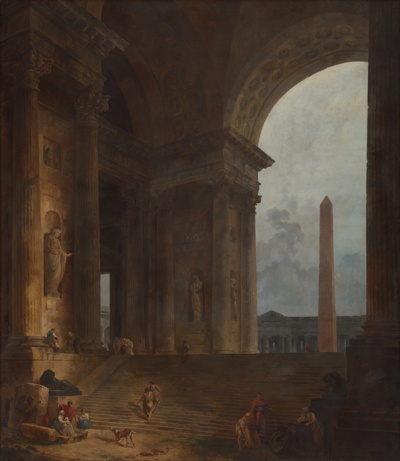
Hubert Robert was the leading French painter of Classical ruins. In 1787 he was commissioned to paint a set of four large canvases for a wealthy financier's château at Méréville, near Paris. The Fountains is one of them. The paintings were set into the panelled walls of a salon, a grand reception room. There they created a kind of second space beyond the elegant Neoclassical decoration around them. Robert had studied in Rome from 1754 to 1765, and that is where he gathered the stock of images he used here. All four paintings are now in the Art Institute of Chicago.
The people in this painting are only there to give scale and life. The true subject is the ruins themselves. Robert's use of ruins reflects an idea put into words by the French philosopher Denis Diderot: everything vanishes, everything dies, only time endures. In this view, people and the buildings they make are small beside nature and time. Look once more at the tiny figures in the foreground, then up at the great structures above them. Ask yourself what this place once was, and how long it has stood broken.
This guide was written by AI from material published by Art Institute of Chicago. Licence: CC BY 4.0
Save this version (English · New to it · Medium) with all its audio, guide text and work image. It replaces the saved guide for this work and language.
Audio storage: about 40 MB per guide and 150 MB on this device. Audio expires 7 days after it is downloaded.
Save this work’s image and museum information on this device to read without a connection.
Ask in your own words. The answer comes from what the museum has written about the work, and says so when that does not hold it.
Image: Art Institute of Chicago, CC0